

Classical music collaborations range from joint compositions and artistic partnerships to modern crossover projects bridging genres. Some works, particularly in the 18th century, were intentionally created in sections for different composers to work on. This April on the Daily Classical Music Post, we’ll explore some of these partnerships and learn why collaboration is one of the cornerstones of classical music.
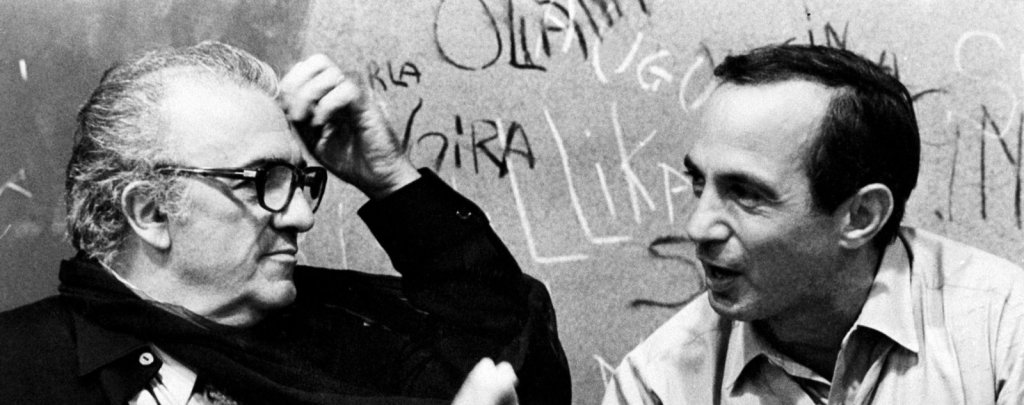
The Italian composer Nino Rota (1911–1979) was already known and admired for his classical compositions, including oratorios and orchestral works, as well as for his film scores, before he met the Italian film director Federico Fellini (1920–1993); Fellini’s niece recalled that her uncle told her, “It was right after the war and we were leaving the headquarters of the production company Lux Film, in Via Po 36, Rome. At the bus stop, I—a thirty-year-old up and coming director—saw Rota, who was already known in Europe for having composed more than fifty soundtracks. I asked him which bus he was waiting for. Rota named a number that did not stop by, but while I was struggling to explain it to him, surprisingly, the bus arrived.” This somewhat improbable but magical meeting led to one of the most significant partnerships in the history of film scoring.
From 1952 to 1979, Rota wrote the music for almost all of Fellini’s films. Fellini said in an interview, “The most precious collaborator I have ever had, I say it straightaway and don’t even have to hesitate, was Nino Rota—between us, immediately, a complete, total, harmony. . . . He had a geometric imagination, a musical approach worthy of celestial spheres. He thus had no need to see images from my movies. When I asked him about the melodies he had in mind to comment on one sequence or another, I clearly realized he was not concerned with images at all. His world was inner, inside himself, and reality had no way to enter it.”
One of Rota and Fellini’s most interesting collaborations was on Casanova di Federico Fellini (1976), a strange and pessimistic reinterpretation of the legendary seducer as a pitiable puppet rather than a romantic hero. The artificial look of the sets, depicting an 18th-century Europe filled with grotesque characters, represents the hollow emptiness of the Casanova myth. The music throughout reflects the hollowness but is at the same time exciting and fascinating.
Randall Roberts wrote, “Those who follow the work of Italian film composer Nino Rota and want to set the mood in a room have a secret weapon in their arsenal, one that touches on ambient music, experimental percussion, Western classical, and Satie-esque miniatures: Casanova di Federico Fellini.” The eerie score, with instrumentation consisting mainly of cello, vibraphone, and synthesizers, stands on its own as well as being an integral part of Fellini’s film.
My classical music post for today is Nino Rota: Casanova di Federico Fellini: “O Venezia, Venaga, Venusia.”


Leave a Reply