

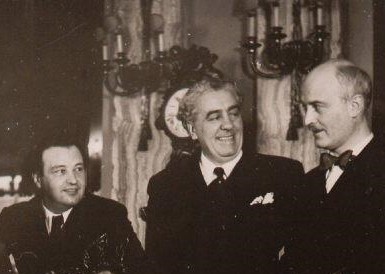
Classical music collaborations range from joint compositions and artistic partnerships to modern crossover projects bridging genres. Some works, particularly in the 18th century, were intentionally created in sections for different composers to work on. This April on the Daily Classical Music Post, we’ll explore some of these partnerships and learn why collaboration is one of the cornerstones of classical music.
L’Aiglon / Arthur Honegger & Jacques Ibert
The French composers Jacques Ibert (1890–1962) and Arthur Honegger (1892–1955) were classmates at the Paris Conservatoire, and they soon became close friends. They worked together on several occasions, perhaps most famously on their 1937 opera L’Aiglon. The librettist, Henri Cain, based his text on the play about the son of Napoleon by Edmond Rostand.
According to Ibert, “It was a car incident that prompted Honegger and I to collaborate. . . . The Rostands and (librettist) Henri Cain had enquired if I would be interested in composing the score for L’Aiglon. They had also thought of Honegger. Both of us hesitated. Destiny decided that one day, when Honegger was with me, my car broke down on the roadside. L’Aiglon appeared as a topic of conversation and so our collaboration was born.” It is believed that Ibert composed Acts I and V, Honegger composed Acts II and and IV, and either Honegger also composed Act III or they both worked on it. However, some people think there was much more collaboration than that, with Ibert composing the waltzes and more lyrical music and Honegger composing the more action-driven music. Neither composer was willing to discuss it, so we’ll never really know.
Max Loppert wrote, “ L’Aiglon is a singular piece of work [with its] blend of operetta, divertissement, conversation piece, historical pageant and, in the disturbingly powerful fourth act set on the Napoleonic battlefield at Wagram, phantasmagoria peopled with living figures onstage and dead voices off.”
Paul E. Robinson wrote, “L’Aiglon premiered (1937) in Monte Carlo. The ‘Eaglet’ of the title was Napoleon’s only son, Napoleon II. When his father was removed from power in 1815, the young man was sent to the court of Austria and given the title, Duke of Reichstadt. The opera deals with Napoleon II’s dreams of continuing his father’s work of making France the dominant power in Europe. Ultimately, his dreams come to nothing, and the opera ends with his death at the age of 21. . . . A fair criticism could be made that the opera begins as operetta and ends as tragedy. The charm of the first three acts is almost totally absent in Acts IV and V. On the other hand, one could argue that this juxtaposition of styles accurately represents the conflict between the outer and inner lives of the ill-fated ‘Eaglet’.”
My classical music post for today is Jacques Ibert and Arthur Honegger: L’Aiglon.


Leave a Reply