

Classical music collaborations range from joint compositions and artistic partnerships to modern crossover projects bridging genres. Some works, particularly in the 18th century, were intentionally created in sections for different composers to work on. This April on the Daily Classical Music Post, we’ll explore some of these partnerships and learn why collaboration is one of the cornerstones of classical music.
Hamelin plays Liszt – Hexameron
Hexaméron, Morceau de concert S.392 for Six Pianos and Orchestra
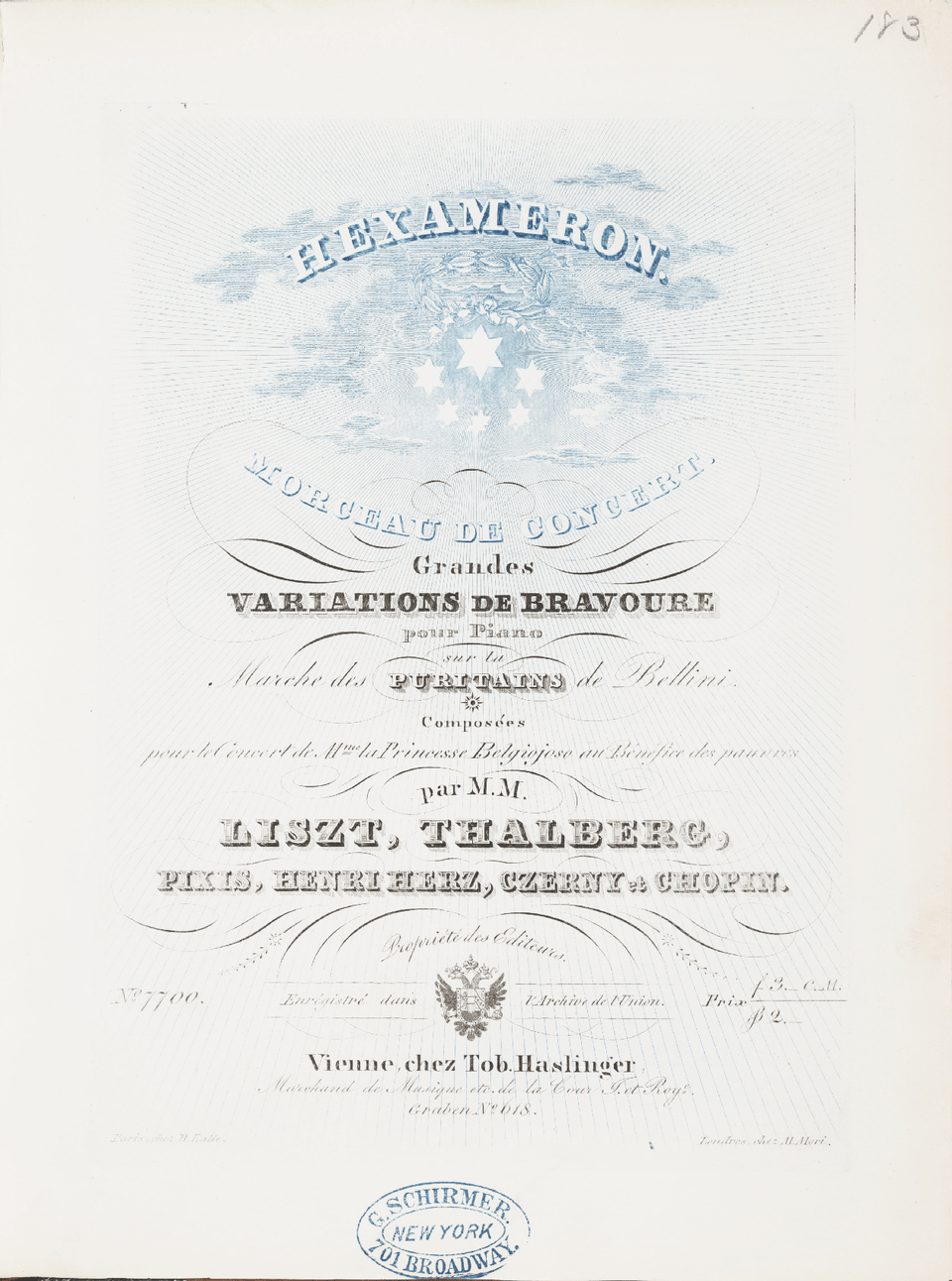
The Italian princess Cristina Trivulzio di Belgiojoso was a patron of the arts, particularly music, and she held salons in her Paris home with Hector Berlioz, Alexis de Tocqueville, Honoré de Balzac, Frédéric Chopin, Alfred de Musset, Victor Hugo, Heinrich Heine, and Franz Liszt, to name but a few, attending and often performing or speaking. It was at one of these soirées that the princess came up with the idea for a collaborative work for piano to be performed in a concert to raise money for the poor. She asked all of the great virtuoso pianist-composers of the day to contribute to this piece, expecting them also to perform it in a grand concert.
Liszt (Hungarian, 1811–1886), Sigismond Thalberg (Austrian, 1812–1871), Johann Peter Pixis (German, 1788–1874), Carl Czerny (Austrian, 1791–1857), Henri Herz (French-Austrian, 1803–1888), and Chopin (Polish, 1810–1849) were each asked to compose variations on the Act II march theme “Suoni la tromba” from Vincenzo Bellini’s opera I puritani. The resulting piece, Hexaméron (composed 1837–1838), is in nine parts: Introduction: Extremement lent (Liszt); Tema: Allegro marziale (transcribed by Liszt); Variation I: Ben marcato (Thalberg); Variation II: Moderato (Liszt); Variation III: di bravura (Pixis)—Ritornello (Liszt); Variation IV: Legato e grazioso (Herz); Variation V: Vivo e brillante (Czerny)—Fuocoso molto energico; Lento quasi recitativo (Liszt); Variation VI: Largo (Chopin)—(coda) (Liszt); and Finale: Molto vivace quasi prestissimo (Liszt).
Dennis Bade wrote, “Unfortunately, several of the composers were tardy in submitting their variations, and the charity performance never took place. When Liszt finally did have each of the contributions, he turned the whole thing into an extravaganza he called Hexaméron, from the Greek term referring to the six days of creation.” The version for solo piano was published in 1839. Liszt also wrote versions for piano and orchestra (also published in 1839) and for two pianos (published in 1870). He left sketches for a version for orchestra and six pianos, and the American composer Robert Linn reconstructed this in 1963. When you listen to the six-piano version, you can imagine the charity performance that never happened: Each pianist sits at a piano, performing their own work, and then everyone joins in for a rousing and massive ending.
My classical music post for today is Franz Liszt, Sigismond Thalberg, Johann Peter Pixis, Carl Czerny, Henri Herz, and Frédéric Chopin: Hexaméron.


Leave a Reply