

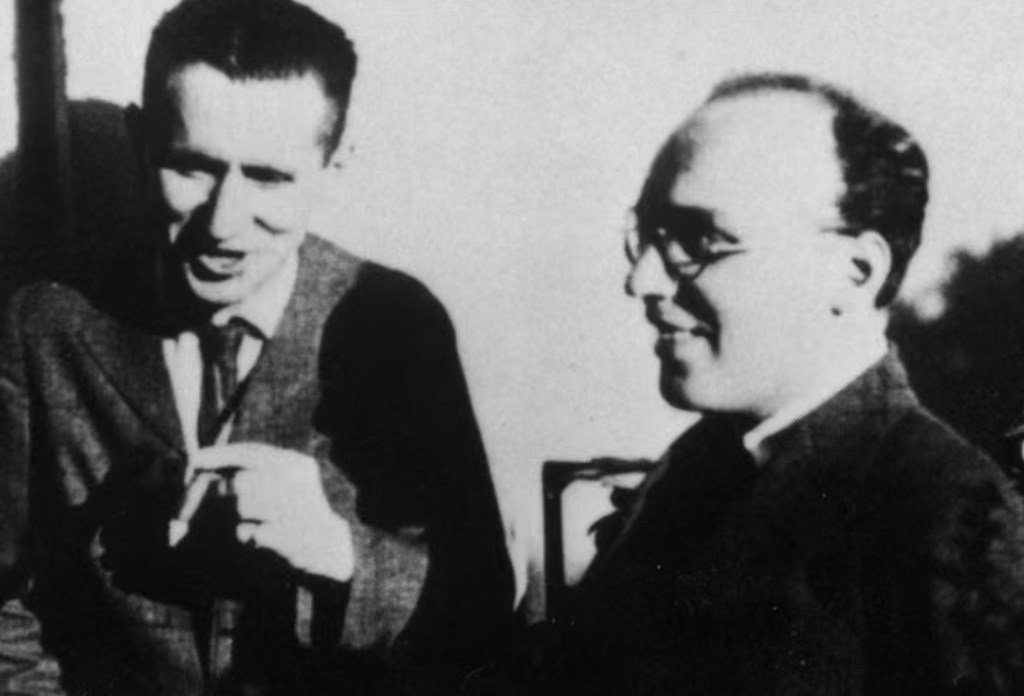
Classical music collaborations range from joint compositions and artistic partnerships to modern crossover projects bridging genres. Some works, particularly in the 18th century, were intentionally created in sections for different composers to work on. This April on the Daily Classical Music Post, we’ll explore some of these partnerships and learn why collaboration is one of the cornerstones of classical music.
Aufstieg und Fall der Stadt Mahagonny: Wie man sich bettet
The German composer Kurt Weill (1900–1950) first worked with the German playwright and poet Bertolt Brecht (1898–1956) in 1927, when they were asked by the Baden-Baden music festival to write a one-act chamber opera. The result of that collaboration, Mahagonny-Songspiel, was performed that year, and Weill and Brecht immediately began the process of reworking it into a full opera. Aufstieg und Fall der Stadt Mahagonny (Rise and Fall of the City of Mahagonny), an “epic opera” with additional text by the German writer Elizabeth Hauptmann, premiered in Leipzig in 1930; although it was performed in other German cities the following year, in 1933 the Nazis banned it.
The libretto was most likely a statement on the immoral and corrupt Weimar Republic of the 1920s. Jonathan Shaw wrote, “‘Wie Mann Sich Bettet’ is one of the most famous tunes from Brecht’s early collaboration with Kurt Weill, Aufstieg und Fall der Stadt Mahoganny, initially staged in Leipzig in March of 1930. The opera is set in America, likely somewhere on Florida’s Gold Coast. Florida was a strange fixation of Weimar Germany’s cultural imaginary, figuring as an elsewhere of plenitude and utopian liberty. Brecht’s opera and its ruthless satire have other ideas: Mahoganny is established by a crew of stranded, fugitive gangsters. They want the town to be a pleasure pit of some renown, replete with high-end brothels, fancy saloons and casinos. The city of Mahoganny grows, populated mostly by prostitutes and schemers. And when a crew of lumberjacks shows up with cash to burn, the opera’s action takes off. The plot rapidly dramatizes a web of nasty betrayals, absurd murders and cynical excess. The song occurs near the end of Act Two, when Jim, one of the lumberjacks and the closest thing to a protagonist the opera musters, has come up short of cash after a night of revelry. He asks his sometime girlfriend and whoring sharpy, Jenny, to loan him the money. She sings the tune, giving Jim the kiss-off—and in so doing, keeping her stack of cash intact and condemning him to death.”
The Austrian singer Lotte Lenya, who was married (twice) to Weill, was the definitive interpreter of her husband’s songs. She was the first Jenny, and her husky voice was perfect for the role. In “Wie Mann Sich Bettet,” she recognizes that in order to survive, someone else has to suffer. This song, and in fact the whole opera, is as relevant and pointed today as it was in 1930. Throughout this piece, as in the whole opera, Weill cleverly employs a variety of styles, including ragtime, jazz, and formal counterpoint, sometimes melodic, other times dissonant, perfectly mirroring the brilliant Brecht text.
My classical music post for today is Kurt Weill: Aufstieg und Fall der Stadt Mahagonny: “Wie Mann Sich Bettet.”


Leave a Reply