

Classical music collaborations range from joint compositions and artistic partnerships to modern crossover projects bridging genres. Some works, particularly in the 18th century, were intentionally created in sections for different composers to work on. This April on the Daily Classical Music Post, we’ll explore some of these partnerships and learn why collaboration is one of the cornerstones of classical music.
Eisenstein / Prokofiev – Alexander Nevsky – The Battle of the Ice
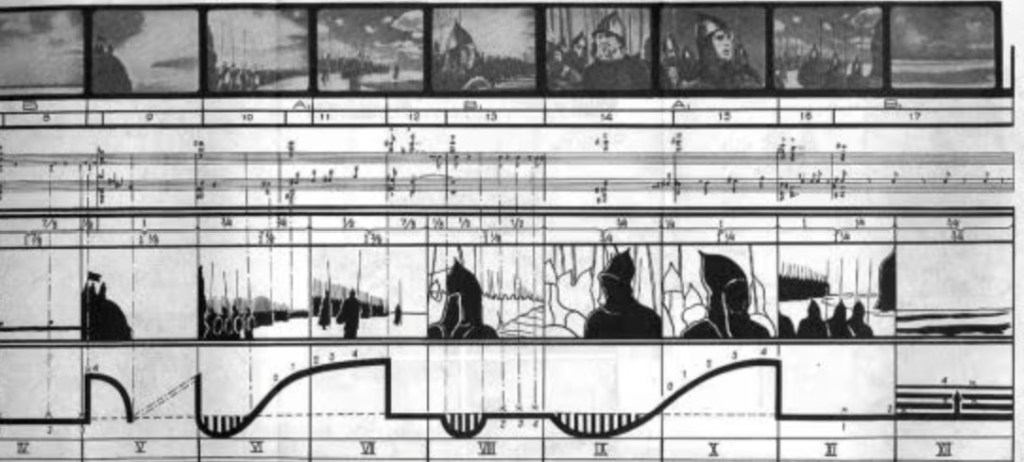
The Russian composer Sergei Prokofiev (1891–1953) and the Soviet film director Sergei Eisenstein (1898–1948) collaborated on just three films: Alexander Nevsky (1938) and the two-part historical epic Ivan the Terrible (Part I released in 1944, Part II in 1958), but their partnership was one of the most important in the history of cinematic sound design. The first of these, the groundbreaking Alexander Nevsky, was a true collaboration: some of the film was shot to Prokofiev’s music and some of the music was composed to Eisenstein’s footage.
Jordan M. Poss wrote, “Eisenstein was a Russian filmmaker who worked for decades making historical dramas for the Stalinist Soviet state. He was also a film theorist, experimenting with intellectual montage techniques to convey story and meaning and—most importantly for a propagandist—evoke emotional reactions. He had a good eye for an exciting sequence, and Alexander Nevsky’s battle on a frozen lake and the wicked Germans’ plunge into the icy depths is among his best.”
The Battle of Lake Peipus took place in 1242 between Prince Alexander Nevsky’s Russian army and Teutonic Knights. In 1938, with tensions rising between Nazi Germany and the Soviet Union, the depiction of the battle in Eisenstein’s film became a propaganda tool, with Stalhelm helmets and swastikas on the Teutons’ helmets and tunics. In 1939, when the Soviet Union and Germany signed the Molotov-Ribbentrop Pact, the film was withdrawn, but in 1941, after Germany invaded Russian territory, it was re-released.
A review of a recording on good-music-guide.com says, “The climactic Battle on the Ice, which takes up half of the movie, is spectacularly staged. . . . The score by Prokofiev has been called the greatest movie score ever written. . . . [The highlight of the music] is the Battle on the Ice, which starts out quietly, ominously and slowly builds to a frenzy depicting the madness of war.”
Prokofiev’s brilliance in composition is evident throughout, particularly in his use of discordant martial-style heavy brass to depict the Teutonic Knights and folksong-like melodic woodwinds and strings to depict the Russians. He later turned the music from Alexander Nevsky into a concert cantata, but there is nothing quite like hearing the music while watching the film.
My classical music post for today is Sergei Prokofiev: Alexander Nevsky: “Battle on the Ice.”


Leave a Reply