

Classical music collaborations range from joint compositions and artistic partnerships to modern crossover projects bridging genres. Some works, particularly in the 18th century, were intentionally created in sections for different composers to work on. This April on the Daily Classical Music Post, we’ll explore some of these partnerships and learn why collaboration is one of the cornerstones of classical music.
Clara Schumann: 3 Lieder, Op. 12: 2. Liebst du um Schonheit
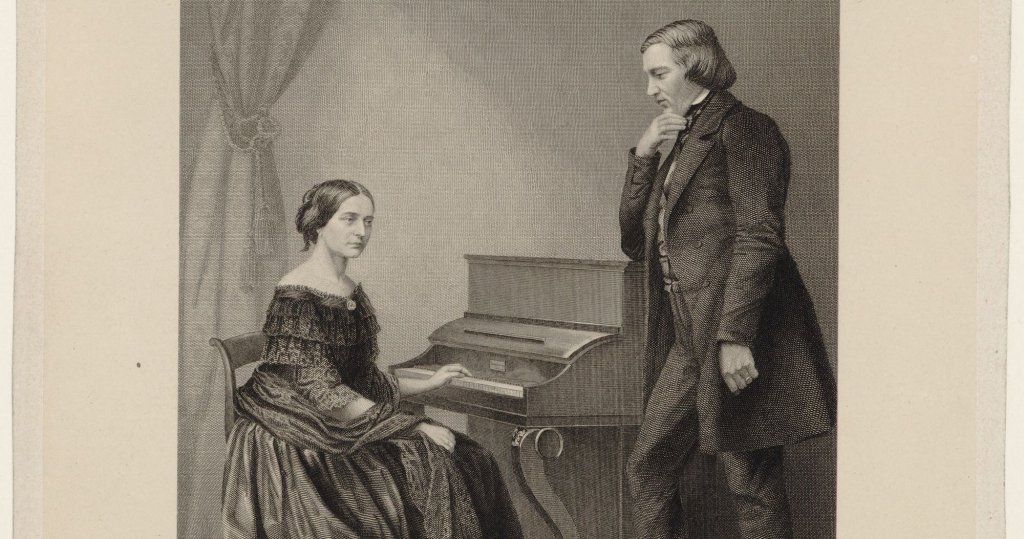
The German composers Clara Wieck (1819–1896) and Robert Schumann (1810–1856) experienced not just romantic love but also a deep respect for each other as musicians and composers. The year before their marriage, Robert wrote to Clara, “We shall publish a good deal under both our names; posterity shall regard us as one heart and one soul and not find out what is yours and what is mine.” Although they were inspired and even sometimes borrowed from each other’s compositions, there is only one actual collaboration between them: Zwölf Gedichte aus F. Rückerts Liebesfrühling von Robert und Clara Schumann (1841).
Zwölf Gedichte aus F. Rückerts Liebesfrühling von Robert und Clara Schumann includes nine songs by Robert and three by Clara. For Robert, the collection was listed as Op. 37, for Clara Op. 12. Robert told the publisher to make sure that none of the songs were ascribed to him or to Clara but rather that the whole collection was to be attributed to both.
Noelle McMurtry wrote, “In fact, without prior knowledge, it was nearly impossible for nineteenth-century critics, performers, and audiences to discern who had specifically composed what, since Robert and Clara’s harmonic and motivic choices within Zwölf Gedichte complemented each other seamlessly. . . . Not only was [Friederich] Rückert one of Robert’s favorite poets, but the poetry itself was an apt choice for the newly married couple.”
Clara actually composed four songs for the collection: “Warum willst du and’re fragen,” “Er ist gekommen,” “Liebst du um Schönheit,” and “Die gute Nacht.” She gave the songs to Robert for his birthday. In the end, “Die gute Nacht” was left out of Zwölf Gedichte aus F. Rückerts Liebesfrühling von Robert und Clara Schumann, but the other three songs were included.
“Liebst du um Schönheit” (If You Love For Beauty) is a simple, yet profound, poem about love. Nadia Smelser wrote that Clara’s song is a “gorgeous setting, with its gently rolling piano, purity of vocal line, and simple declaration of love for love’s sake. . . . Clara Schumann’s “Liebst du um Schönheit” stands the test of time for lovers everywhere, and stands as an enduring reminder of the talent and character of one of the most pivotal women in music history”
My classical music post for today is Clara Schumann: “Liebst du um Schönheit.”


Leave a Reply