

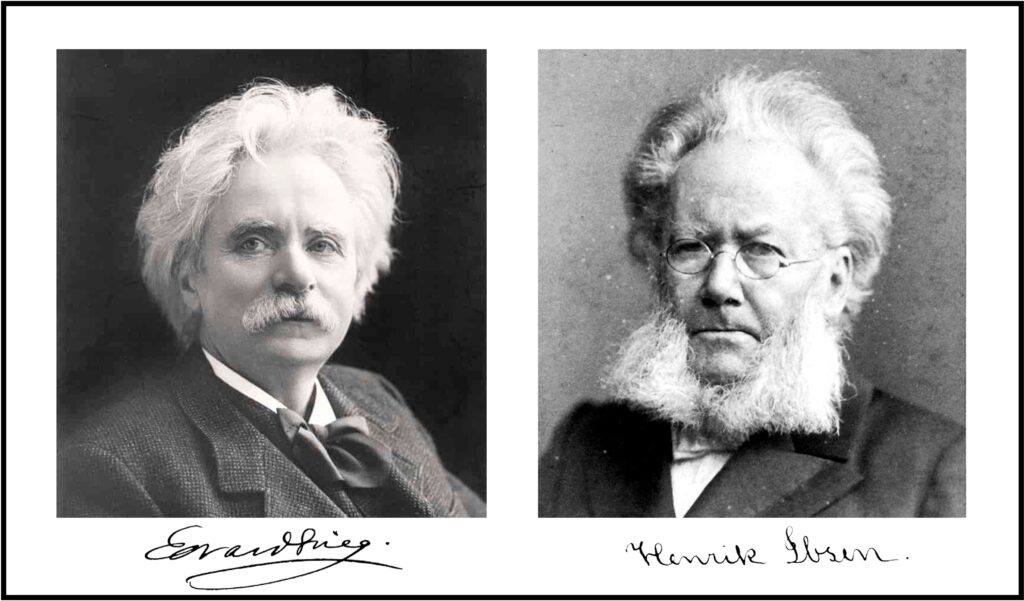
Classical music collaborations range from joint compositions and artistic partnerships to modern crossover projects bridging genres. Some works, particularly in the 18th century, were intentionally created in sections for different composers to work on. This April on the Daily Classical Music Post, we’ll explore some of these partnerships and learn why collaboration is one of the cornerstones of classical music.
6 Poems, Op. 25: No. 3, Stambogsrim (Album Lines)
Many classical music lovers know the beautiful incidental music that the Norwegian composer Edvard Grieg (1843–1907) wrote in collaboration with the Norwegian playwright Henrik Ibsen (1828–1906) for Ibsen’s play Peer Gynt in 1874–1875. Although Grieg and Ibsen had been friends since 1866, they had not worked together before this. Ibsen had not intended for his play, written in verse, to be staged, but when he changed his mind he asked Grieg to compose music for the production. Grieg was not happy at all throughout the commission; he felt that the play was “unmusical” and that Ibsen and the Swedish producers were too demanding. However, in the end, Grieg wrote 26 pieces, and many of these, including “Morning Mood” and “In the Hall of the Mountain King,” became enormously popular very quickly, particularly after Grieg organized some of the music into two suites.
The difficulties that Grieg faced while composing the music for Peer Gynt did not sour him on Ibsen’s poetry, however, and in 1876, during a time of depression, Grieg turned to six poems by his friend for his song cycle Six Poems by Henrik Ibsen, Op. 25 (1876). Georg Predota wrote, “In 1876, Grieg found Ibsen’s fateful poetry a match for his own state of mind. He had lost both his parents within a short period of time, ‘each strangely dying a day before an advertised concert, which then had to be cancelled.’ In addition, his marriage was going through a rather unsettled period, and Grieg poured his anguish into his music.”
The third song in the cycle, “Stambogsrim” (Album Lines), is Grieg’s shortest art song. Grieg packs an enormous amount of emotion into 12 short bars. The text, about a loved one who is no longer there, is presented in a lyrical ABA form, in a minor key with syncopated accompaniment. Robert Matthew Walker wrote, “‘Stambogsrim’ (‘Album lines’), depicts—as Beryl Foster has said—‘a scene barely glimpsed rather than seen properly’. This twelve-bar song (the shortest in Grieg’s entire output) reflects aspects of early settings by contemporaneous French Impressionists—Fauré, perhaps, or Duparc—in its subtleties and inferences, characteristics which are further alluded to in the other songs in the group. A study of the texts and of Grieg’s inspired reactions to them through his distinctive melodic lines and their harmonic accompaniments reveals the deepening of the composer’s art by this time.”
My classical music post for today is Edvard Grieg: Six Poems by Henrik Ibsen: 3. “Stambogsrim.”


Leave a Reply