

Classical music collaborations range from joint compositions and artistic partnerships to modern crossover projects bridging genres. Some works, particularly in the 18th century, were intentionally created in sections for different composers to work on. This April on the Daily Classical Music Post, we’ll explore some of these partnerships and learn why collaboration is one of the cornerstones of classical music.
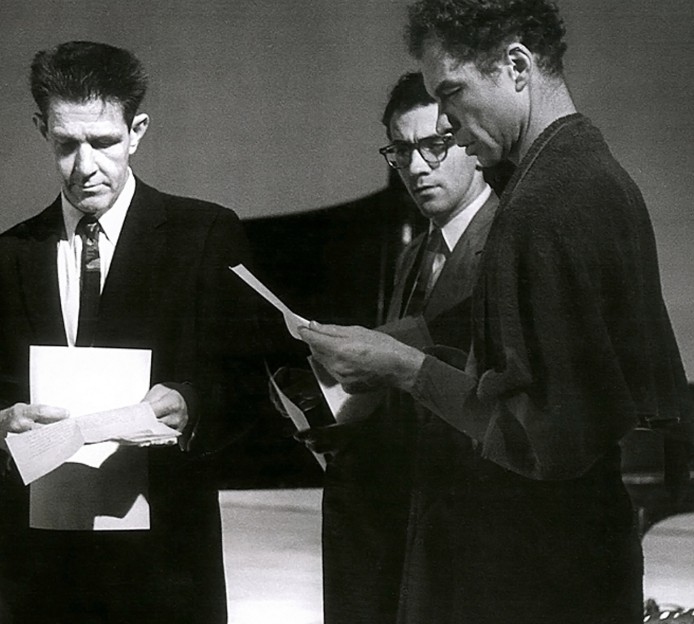
In the early 1950s, the American composer John Cage (1912–1992), the American dancer and choreographer Merce Cunningham (1919–2009), and the American pianist and composer David Tudor (1926–1996) formed what was to be one of the most groundbreaking trios of the 20th-century avant-garde movement. Many of their collaborations included the Merce Cunningham Dance Company as well as up-and-coming filmmakers and visual artists. The trio’s first major collaboration was Theatre Piece No. 1, premiered in North Carolina in the summer of 1952, described as the first Happening. This partnership produced hundreds of performances and continued until Cage’s death.
In 1965, Cage, Cunningham, and Tudor were commissioned by The French American Festival to create a multi-media work. Variations V was filmed in Hamburg. The Merce Cunningham Trust website has this description of Variations V: “The piece involved dancers, musicians, and technicians, as well as electronic equipment, some especially designed by Bell Laboratories. Twelve sound sensitive electronic poles were placed around the stage. Each pole had a four foot sound radius. The sound was triggered by the dancer’s movements and was then altered or delayed by the musicians, John Cage, David Tudor and Gordon Mumma shown at work nearby. Another experimental element in this piece involved the use of film. Stan VanDerBeek filmed rehearsals of the dancers, shooting around, but not disturbing them. VanDerBeek used this footage as well as other images, such as still shots from movies and a montage of contemporary scenes. Korean artist Nam June Paik developed ways of changing some of the images and projected them on television screens during the performance. A number of non-dance related activities were also included in the work. Cunningham potted a large plant and Carolyn Brown repotted it. The plant had a cartridge microphone attached to it so that any quiver would produce sound. At the end of the piece, Cunningham rode a bicycle through the space, around the poles and the photo-electric cells, and then exited.”
Mark Sealey wrote, “Cage’s work in the 1960s recognized the vital new role that technology was already playing (and would come to play) in artistic expression in general, and music in particular.” Variations V is a wonderful way to experience just a little of the vibrancy of musical and multimedia experimentation from the second half of the 20th century.
My classical music post for today is John Cage: Variations V.


Leave a Reply