

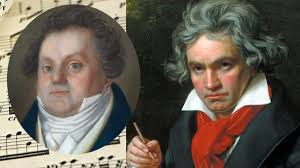
Classical music collaborations range from joint compositions and artistic partnerships to modern crossover projects bridging genres. Some works, particularly in the 18th century, were intentionally created in sections for different composers to work on. This April on the Daily Classical Music Post, we’ll explore some of these partnerships and learn why collaboration is one of the cornerstones of classical music.
Lob auf den Dicken in G Major, WoO 100 “Schuppanzigh ist ein Lump”, musical joke
The German composer Ludwig van Beethoven (1770–1827) met the Austrian violinist Ignaz Schuppanzigh (1776–1830) in Vienna in 1792, and they became best friends immediately (although Beethoven was a bit annoyed with Schuppanzigh when the latter took him to a brothel early on in their friendship). Schuppanzigh taught Beethoven to play violin, and he also was Beethoven’s musical collaborator, advising on string technique and premiering many of Beethoven’s works, including the Rasumowsky quartets, the Ninth Symphony (as leader), and the late string quartets.
Schuppanzigh was famously obese, and Beethoven gave him the nickname “Mylord Falstaff,” or “Falstafferl,” after the comic Shakespeare character. Schuppanzigh was always complaining about having to climb four floors to reach Beethoven’s apartment, which irritated Beethoven. But the two men remained close friends and collaborators until Beethoven’s death. Schuppanzigh helped with proofing and copying many of Beethoven’s later string quartet scores.
Schuppanzigh was enormously important for Beethoven’s career; Peter Sheppard Skaerved wrote, “Beethoven needed Schuppanzigh’s access, not only to the leading musicians who came through the various elevated salons in Vienna, but also to the ‘wheels within wheels’ of Viennese high society, the uneasy meeting point between first and second ranks of nobility, which carried on its dance, between finance and influence, in the closed-door salons of the most rarefied masonic lodges.”
Beethoven immortalized his friendship with Schuppanzigh in a humourous little choral ditty called “Lob auf den Dicken” (WoO 100), composed in 1801. This piece, for three solo voices and choir, was the first musical joke that Beethoven composed and was dedicated to Schuppanzigh, mocking him affectionately: “Schuppanzigh is a scoundrel / Who doesn’t know him, / the fat sour-belly / the conceited ass’s head? / Oh scoundrel Schuppanzigh / Oh donkey Schuppanzigh / We all agree / that you are the biggest ass / Oh ass, hahaha.” Well, maybe that’s what passed for affectionate mockery in 1801.
Beethoven also wrote another piece for Schuppanzigh, “Falstafferl, lass’ dich sehen” (WoO 184), in 1823. This canon for five voices is marginally less insulting than “Lob auf den Dicken,” and the title, “Little Falstaff, show yourself,” is probably as affectionate as Beethoven ever got with anyone.
My classical music post for today is Ludwig van Beethoven: “Lob auf den Dicken.”


Leave a Reply