

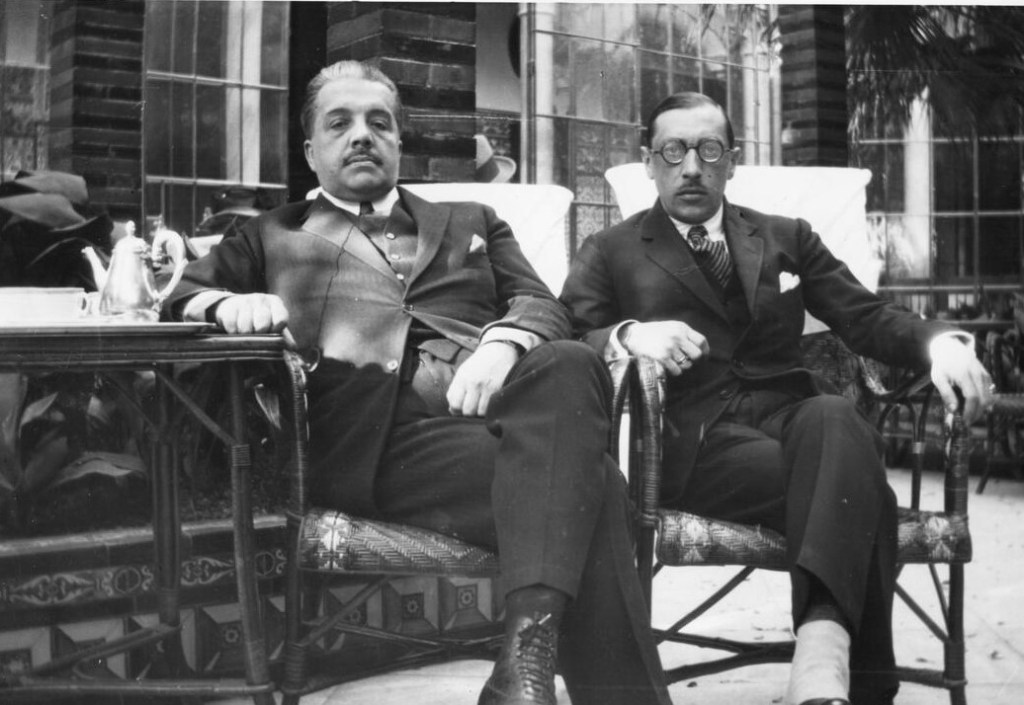
Classical music collaborations range from joint compositions and artistic partnerships to modern crossover projects bridging genres. Some works, particularly in the 18th century, were intentionally created in sections for different composers to work on. This April on the Daily Classical Music Post, we’ll explore some of these partnerships and learn why collaboration is one of the cornerstones of classical music.
Stravinsky: The Firebird (L’oiseau de feu) – Ballet / 1. Tableau: Infernal Dance Of Kastchei’s…
The Russian composer Igor Stravinsky (1882–1971) and the Russian impresario Sergei Diaghilev (1872–1929), founder of the Ballets Russes, worked together for 20 years on some of the most extraordinary ballets ever produced. The list of their collaborations contains some of the most influential music of the first half of the 20th century: The Firebird (L’oiseau de feu, 1910), which was the first original score that Diaghilev commissioned from Stravinsky; Petrushka (1911); The Rite of Spring (Le Sacre du Printemps, 1913), famous for the near riot at the premiere and for Vaclav Nijinsky’s “vulgar and primitive” choreography; Pulcinella (1920), with sets and costumes by Pablo Picasso; Les Noces (The Wedding, 1923), a “choreographed Russian scene with singing and music”; Renard (1922); and Apollon musagète (Apollo, 1928), one of their final collaborations, choreographed by George Balanchine.
Diaghilev first heard Stravinsky’s music in 1909 at a concert in Saint Petersburg, and he asked the young composer to orchestrate music by Frédéric Chopin for his new production for the Ballets Russes, Les Sylphides, which Stravinsky completed in just a few weeks. Diaghilev then had an idea for a new ballet to be based on a Russian folk tale with Russian music, and after he was turned down by several older, more established Russian composers, he turned to Stravinsky. It was one of the best decisions that he ever made.
The Firebird is in two tableaus. Prince Ivan, with the help of a magical Firebird, defeats the immortal sorcerer Kastchei. Near the end of the first tableau, Ivan summons the Firebird with a feather that she gave to him. The Firebird arrives and causes Kastchei and his followers to enter a wild dance (“Infernal Dance of All Kashchei’s Subjects”), and they all drop from exhaustion. It’s an exhilarating and somewhat frightening moment, and the music is absolutely extraordinary.
The French critic Robert Brussel heard the music in a private piano score performance before the premiere. He wrote: “By the end of the first scene, I was conquered: by the last, I was lost in admiration. The manuscript on the music-rest, scored over with fine pencillings, revealed a masterpiece.” The music was so well received that Stravinsky arranged three orchestral suites for concert performance in 1911, 1919, and 1945. The suites are still popular with audiences today.
My classical music post for today is Igor Stravinsky: The Firebird: “Infernal Dance of All Kashchei’s Subjects.”


Leave a Reply