

Classical music collaborations range from joint compositions and artistic partnerships to modern crossover projects bridging genres. Some works, particularly in the 18th century, were intentionally created in sections for different composers to work on. This April on the Daily Classical Music Post, we’ll explore some of these partnerships and learn why collaboration is one of the cornerstones of classical music.
Violin Concerto in D Major, Op. 77: I. Allegro non troppo
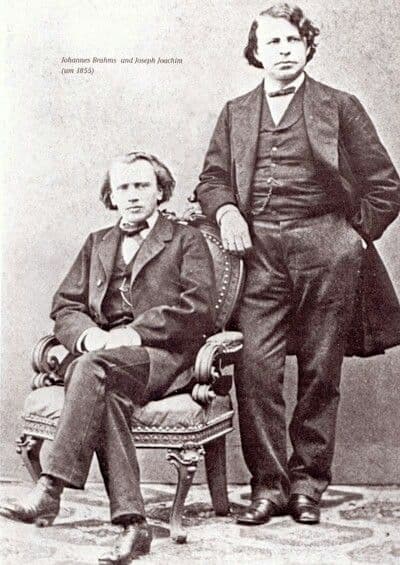
The German composer Johannes Brahms (1833–1897) and the Hungarian violinist Joseph Joachim (1831–1907) had one of the most profound and long-lasting artistic partnerships of the 19th century. Clemens Matuschek wrote, “Their paths crossed for the first time in 1848, in Brahms’s native city of Hamburg. . . . In 1853 Brahms came to Hanover, where Joachim was then concertmaster of the court orchestra, on a tour as accompanist to the Hungarian violinist Eduard Reményi. Although Brahms was still a newcomer, the two immediately recognized each other as brothers in spirit. ‘I have never before come across so great a talent,’ Joachim enthused. ‘His playing shows an intense fire and the energy and precision which bodes well for the artist, and his compositions already bespeak such power as I have seen in no other musician of his age.’ When Reményi suddenly left Brahms in the lurch shortly afterwards, the path was clear for a personal and musical partnership that would go down in musical history.”
In those early years, Joachim was the mentor and Brahms the mentee; Joachim provided technical advice on Brahms’s works for the violin and he also premiered many of Brahms’s compositions. Joachim knew many of the most important musicians and patrons of the day, and he introduced Brahms to them. He also gave Brahms the confidence to introduce himself to Franz Liszt and Clara and Robert Schumann.
Perhaps the most important result of the Brahms–Joachim collaboration was Brahms’s Violin Concerto in D Major, Op. 77, composed in 1878. The concerto was dedicated to Joachim, who premiered it in Leipzig on New Year’s Day, 1879. Joachim also wrote the cadenza to the first movement. Brahms conducted the orchestra at the premiere. It was not an unqualified success; many contemporary critics felt that the violin was too much a part of the orchestra (sort of like the viola in Hector Berlioz’s Harold en Italie).
Although Joachim thought this concerto was one of the four best in the repertoire (the other three were, in his view, those by Ludwig van Beethoven, Max Bruch, and Felix Mendelssohn), his friendship and partnership with Brahms cooled off considerably around the time of the premiere, after Joachim’s marriage ended in divorce, as Brahms took Joachim’s wife’s side. It wasn’t until 1887, when Brahms composed the Double Concerto in A minor for violin and cello, Op. 102, for Joachim, that their partnership was revived. Their friendship lasted until Brahms’s death.
My classical music post for today is Johannes Brahms: Violin Concerto in D Major, Op. 77: I. Allegro non troppo.


Leave a Reply