

Composers leave works unfinished for many different reasons including untimely death, loss of inspiration, perfectionism, and, in some cases, a feeling that the work is already complete despite being technically incomplete. This February, the Daily Classical Music Post will explore unfinished works and find out the ways in which they are performed today, either still incomplete or finished by other composers.
Karl Amadeus Hartmann Gesangsszene
The German composer Karl Amadeus Hartmann (1905–1963) is considered to be the greatest 20th-century German composer of symphonies. He studied with Anton Webern, and although his musical style is very different from that of Webern, he felt that he benefitted from Webern’s perfectionism. Hartmann’s music is sometimes reminiscent of Anton Bruckner, sometimes Gustav Mahler, sometimes an amalgam of musical expressionism and jazz, and sometimes something all his own. Hartmann was opposed to the Hitler regime and as a result his music was not published or performed until after World War II.
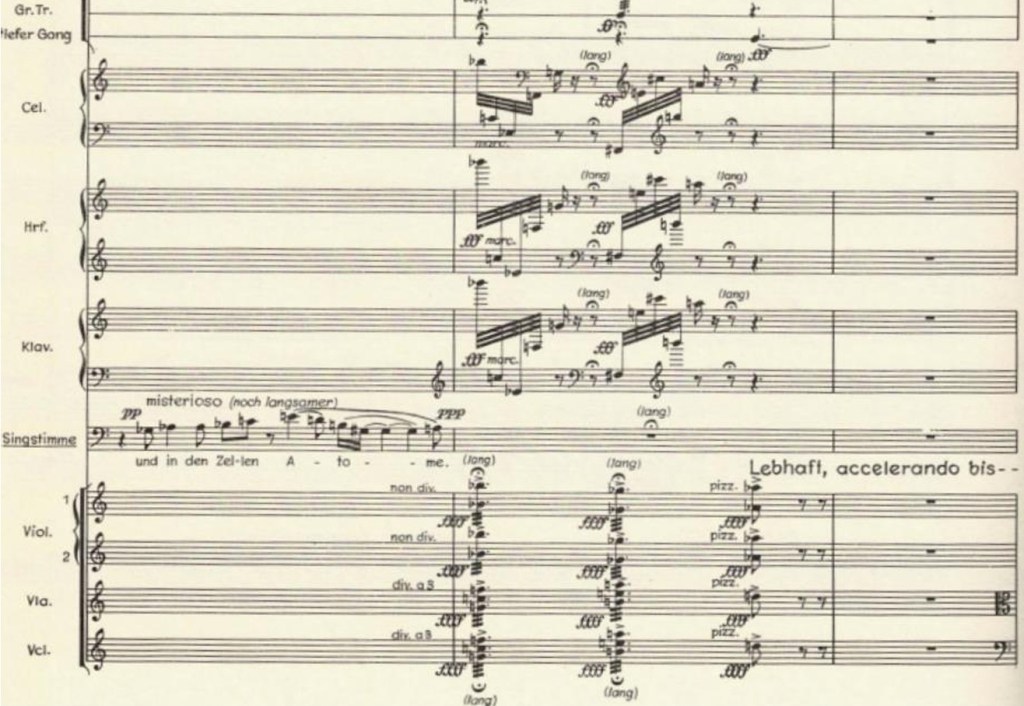
Byron Adams wrote, “A moving example of Hartmann’s determination to use music to comment broadly on politics and culture is his final score, the Gesangsszene (‘Song Scene’) for baritone and orchestra. Begun in 1961, at the height of the Cold War when nuclear annihilation was a real and present danger, this score was left unfinished at the composer’s death two years later; it was premiered on September 12, 1964 by the great baritone Dietrich Fischer-Dieskau, for whom the work was written. For his text, Hartmann chose a German translation of a literally apocalyptic passage from Sodome et Gomorrha, the last play by the French author Jean Giraudoux (1882–1944). Produced during the German occupation of France in 1943, Giraudoux’s Sodome et Gomorrha takes as its subject the impossibility of love in the midst of an endemic societal corruption that leads inexorably to destruction. From the achingly vulnerable opening flute solo, Hartmann traces the agony of a text that speaks of ‘lice on the head of bald millionaires’ and the fiery destruction of the proud and technologically advanced Cities of the Plain:’“Es ist ein Ende der Welt!’ As the score nears its conclusion, the music suddenly ceases at the moment when death snatched the pen from Hartmann’s hand, so that the last two lines of the text are spoken unaccompanied: the most devastating and true ending possible for this harrowing score.”
Tim Page wrote in his review of the American premiere of Gesangsszene in 1983, “The text, by Jean Giraudoux, is one of those gloomy, end-of-the-universe affairs that passed as profundity for a couple of decades after World War II. On this unpromising foundation, Hartmann built a musical construction of solidity, color and originality, with a marked absence of extraneous angst. While there is passion here, it is inevitably tempered with classical dignity. In the United States, Hartmann’s music, which defies easy description, has never been awarded the attention it deserves. Certainly Hartmann, a child of his time, betrays his heritage; ‘Gesangsszene’ called to mind Pfitzner’s orchestral songs, Mahler’s later symphonies, Schoenberg’s ‘Gurre-Lieder’ and ‘Survivor From Warsaw’ and, especially, Webern’s Six Pieces for Large Orchestra. But Hartmann manages to combine these varying influences into an esthetic hybrid that is entirely his own.”
My classical music post for today is Karl Amadeus Hartmann: Gesangsszene.


Leave a Reply