

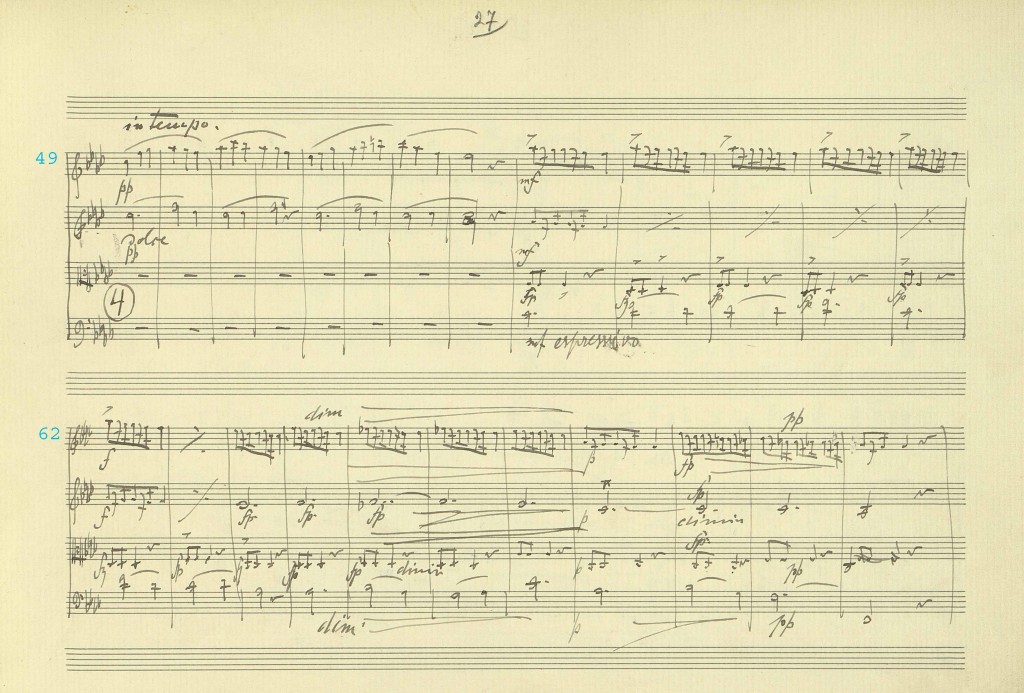
Composers leave works unfinished for many different reasons including untimely death, loss of inspiration, perfectionism, and, in some cases, a feeling that the work is already complete despite being technically incomplete. This February, the Daily Classical Music Post will explore unfinished works and find out the ways in which they are performed today, either still incomplete or finished by other composers.
Quartet Movement in F Major, B. 120
The Czech composer Antonín Dvořák (1841–1904) began working on a string quartet in F major in the autumn of 1881. He abandoned that work, concentrating instead on his quartet in C major and then an opera. He never returned to the F major quartet. The manuscript was found with his papers and the first performance of what was called the Quartet Movement in F Major, B. 120 took place in 1945. The movement was later published in 1951.
Keith Anderson wrote, “Marked Allegro vivace, the movement starts with what sounds like a slow introduction, but without change of tempo this leads to material of seamless melodic invention. The exposition, which ends in the key of the closing subject, A minor, is repeated and there is a central development, before the eventual return of the opening figuration in the tonic key and the recapitulation. The movement ends in gentle serenity, but remains highly characteristic of its composer throughout, immediately recognisable in its rhythms, its textures and its melodic content.”
Dvořák composed the movement in just three days. The movement is intense, urgent, and energetic. Unlike many of his later works, there’s no hint of the influence of folk music, but the late-Romantic tone and dramatic tension make it very appealing. Like many of the other works we’ve looked at this month, although the movement is apparently part of an incomplete string quartet, it very definitely stands on its own.
My classical music post for today is Antonín Dvořák: Quartet Movement in F Major.


Leave a Reply