

Composers leave works unfinished for many different reasons including untimely death, loss of inspiration, perfectionism, and, in some cases, a feeling that the work is already complete despite being technically incomplete. This February, the Daily Classical Music Post will explore unfinished works and find out the ways in which they are performed today, either still incomplete or finished by other composers.
The French composer Léo Delibes (1836–1891) was best known for his operas and ballets. His music was admired for its “wit, charm, elegance, grace, color, and lightness,” and the “Flower Duet” from his opera Lakmé is one of the most popular duets for sopranos in the repertoire.
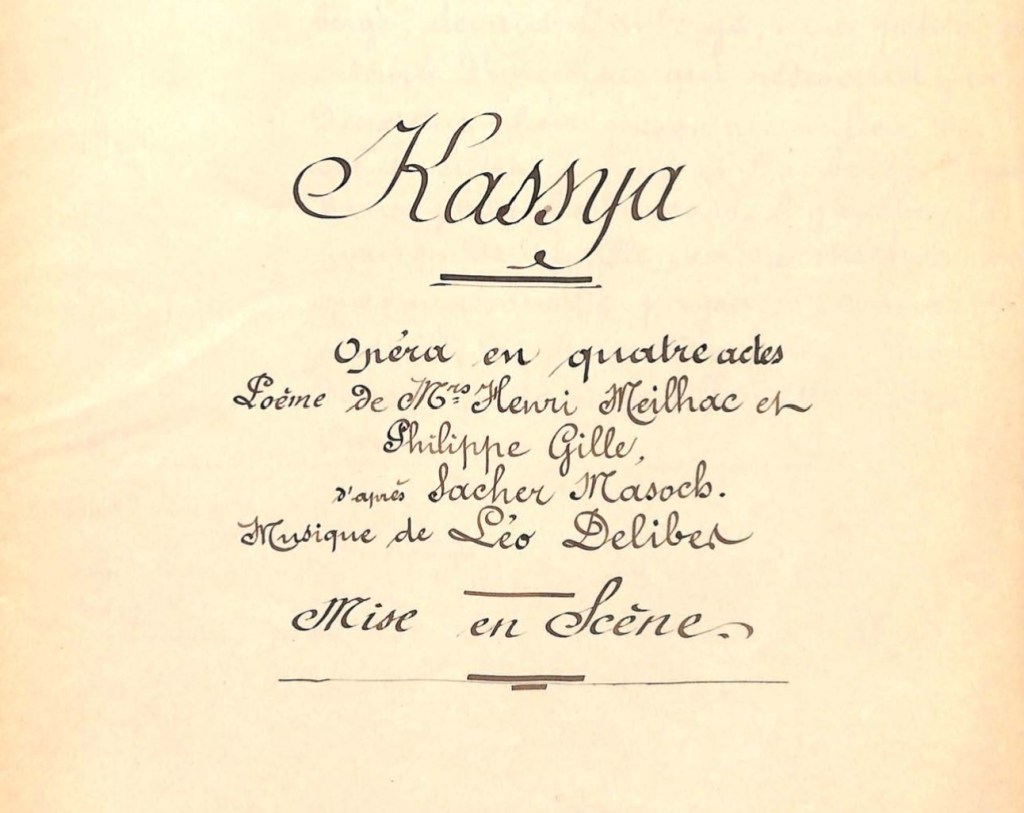
Delibes was hard at work on Kassya, an opera in 4 acts and 5 tableaux, when he suddenly died at the age of 55. The libretto by Henri Meilhac and Philippe Gille was based on a Galician tale by Leopold von Sacher-Masoch (the man who was the inspiration for the term “masochism”). Delibes travelled to Galicia to get a feel for the people and the place before composing the music. The opera tells the story of the peasant Cyrille, who abandons his loving village girl, Sonia, for the gypsy Kassya, leading to jealousy, betrayal, and a dramatic downfall set against a turbulent Galician backdrop.
Although much of the opera was ready in vocal and piano score, the orchestration was not completed. Georg Predota wrote, “It was left to his colleague Jules Massenet, who had accompanied Delibes on his earlier trip to Galicia, to complete the work. Massenet furnished the orchestration and turned the spoken dialogues into sung recitatives.” Massenet finished the editing and orchestration in early 1893, and the opera received its premiere in Paris in March of that year.
Nicholas Fuller wrote, “Despite the opera’s long gestation, it was not a success, and left the theatre after eight performances. ‘The drama,’ Arthur Pougin (Dictionnaire des opéras) wrote, ‘was colourful and picturesque, but the character was rather sombre, the tone rather violent, and the story not interesting enough. It was like a series of curious, animated, sometimes strange pictures, connected by a somewhat timid and tenuous story. This was a blow to the success of the work, which, from the musical point of view, contained pages worthy of the author of Lakmé and Le Roi l’a dit’.”
Kassya was mostly forgotten, and although there was a semi-staged performance in France in 2024, it’s almost impossible to find any recordings of anything other than the Prelude and one of the dances from Act IV. It would be interesting to hear the arias, as critics at the time did praise Delibes’ vocal writing in this opera.
My classical music post for today is Léo Delibes: Kassya: Trepak.


Leave a Reply