

December is a month for reflection, a time to look back on the past year before looking ahead to the new one. In 2025, there was so much great music to share that I wasn’t able to fit all of it in! So this December, the Daily Classical Music Post will revisit the theme for each month and share a few of the works that didn’t make the cut.
[May 2025: The first day of May is International Workers’ Day. Workers and the labour movements are celebrated worldwide on this day. This May, the Daily Classical Music Post will honour and commemorate the struggles, achievements, rights, and gains of workers through music.]
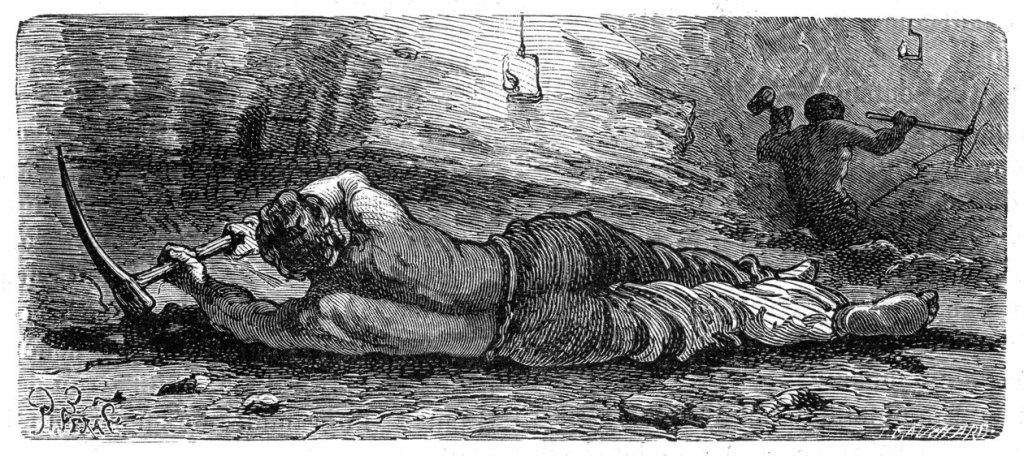
People have mined for coal since the earliest recorded times. Deep shaft mining, the most difficult and dangerous method of extraction, developed in the late 16th century, and coal increasingly became important as a source of fuel during the Industrial Revolution. Although there have been changes in the methods of coal mining in the last half-century, it is still one of the most dangerous professions in the world.
The Austrian composer Franz Schubert (1797–1828) portrayed miners’ struggles and courage in “Bergknappenlied” (D. 268) a four-part part-song for male (TTBB) chorus and piano composed in 1815. The text by Gotthold Friedrich Stäudlin depicts miners descending into a mineshaft, facing their dangerous job with courage and faith.
Mark Rochester wrote, “Schubert composed around 110 works for male voice chorus. . . . These songs were composed for performance at small gatherings of friends and there’s a lovely story of how, when Schubert turned up without a new piece, he was locked in a room with a book of poetry and not let out until he had written something to be sung. It’s an important aspect of Schubert’s output, not only because it shows him in a wonderfully relaxed and often light-hearted vein, but also because it was in this genre . . . that he first made a name for himself as a serious composer; part-songs originally written for private performance were so good that they soon found their way into the concert-hall.”
Graham Johnson wrote, “The music looks and sounds so like a battle march that the text can all too easily be misread, as if men were going into battle (‘in der Schlacht’) rather than down into the shaft (‘in den Schacht’). . . . [T]he struggle against the enemy is simply the miserable job of fighting to extract coal or ore of some kind from the ground and the composer makes the miners face the dangers of the depths with a combination of military spirit and religious faith which was absolutely typical of the war songs of the period. . . . Certainly this miners’ song is unlike anything else in Schubert’s output which otherwise avoided contact with the stressful occupations of the Industrial Revolution.”
My classical music post for today is Franz Schubert: “Bergknappenlied.”


Leave a Reply