

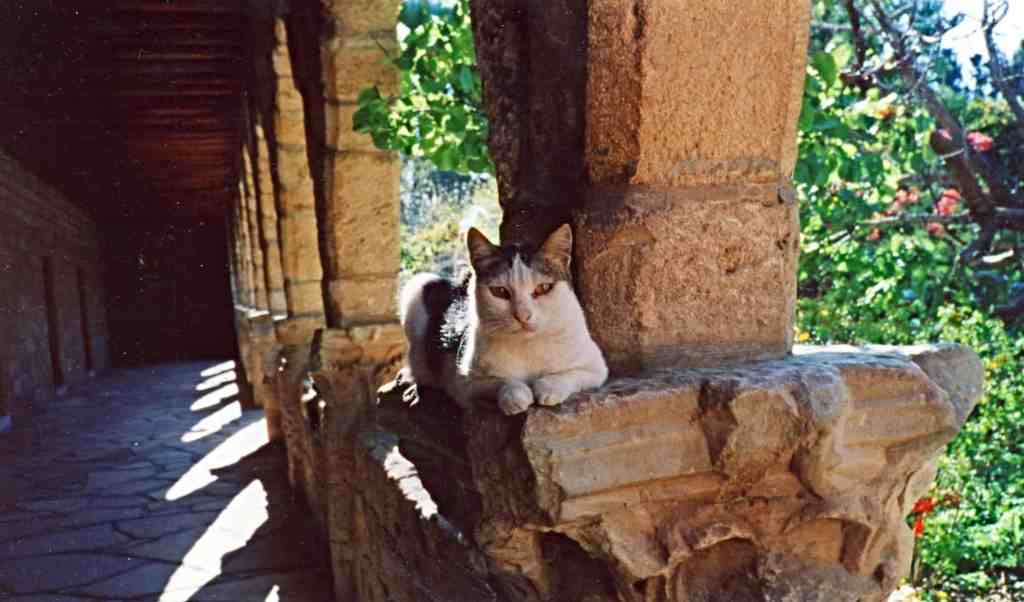
December is a month for reflection, a time to look back on the past year before looking ahead to the new one. In 2025, there was so much great music to share that I wasn’t able to fit all of it in! So this December, the Daily Classical Music Post will revisit the theme for each month and share a few of the works that didn’t make the cut.
Barber: Hermit Songs Op. 29 – 8. The Monk and His Cat
[April 2025: A is for April, and it’s also for Animals! This April, the Daily Classical Music Post explores music celebrating the animal kingdom.]
“It occurs to me that perhaps the cat is a monk.”—Ruskin Bond
The American composer Samuel Barber (1910–1981) wrote Hermit Songs in 1953. This setting of a collection of anonymous poems written by Irish monks and scholars from the 8th to the 13th centuries, was the result of a commission that Barber received from the Elizabeth Sprague Coolidge Foundation. Barber wrote, “[The songs] are settings of anonymous Irish texts of the eighth to thirteenth centuries written by monks and scholars, often on the margins of manuscripts they were copying or illuminating—perhaps not always meant to be seen by their Father Superiors. They are small poems, thoughts or observations, some very short, and speak in straightforward, droll, and often surprisingly modern terms of the simple life these men led, close to nature, to animals and to God.”
Jane Vial Jaffe wrote, “The ten songs vary considerably in length and mood according to their subjects. . . . But they make a cohesive group based in part on ancient-sounding fourths and fifths and other shared motivic material (a descending whole tone followed by a descending fourth appears in eight of the songs). Whether fast or slow, jaunty or reflective, Barber’s style of declamation fits the text precisely because he allows unhampered metric flow by omitting time signatures altogether. Attested to by the frequency of their performance and by the remarkable number of studies devoted to both their textual and musical analysis, the Hermit Songs rank among the great song cycles of the twentieth century.”
The text of “The Monk and His Cat” was taken from an 8th- or 9th-century Old Irish anonymous poem, “Pangur Bán,” written in the margins of an illuminated manuscript by an Irish monk, and it was translated for Barber by W. H. Auden. Calum MacDonald wrote, “Perhaps the best-loved of all these songs is ‘The Monk and his Cat’, on a poem famous in cat literature, beginning ‘Pangur, white Pangur, / How happy we are’. Here the lazy flowing rhythm, the piano’s mewing crushed seconds, and the bluesy harmony conjure up a warm impression of perfect human-feline contentment.”
My classical music post for today is Samuel Barber: Hermit Songs: “The Monk and His Cat.”


Leave a Reply