

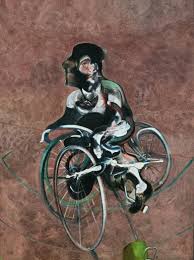
There are two categories of classical music that use visual art as the subject of the composition. “Inspired-by” music takes a work of art as a notional starting point, whereas “ekphrastic” music aims to comment on or illuminate the visual artwork. This November, the Daily Classical Music Post will explore music based on visual art from the Renaissance to the 21st century.
6 Studies of Francis Bacon: V. George and the Bicycle
The British figurative painter Francis Bacon was known for his unsettling images. Most of his work focused on the human or animal form, and religious objects, particularly the cross, featured in many paintings. Although there are nearly 600 works extant, Bacon destroyed hundreds more.
Bacon was in a very stormy relationship with George Dyer, a much younger man who was a petty criminal, from 1963 until Dyer’s death in 1971. According to the Francis Bacon Estate website, “Bacon painted portraits of Dyer obsessively, both during his life and after Dyer’s death.” Portrait of George Dyer Riding a Bicycle (1966, oil and sand), is one of the many paintings featuring Dyer. The expressionist work shows a blurred figure inside a larger shadowy figure on a bicycle.
The Javanese/Dutch-born British composer Gerard Schurmann (1924–2020) is best known for his film scores and orchestrations. His classical output ranges from chamber and solo instrumental music to large-scale orchestral pieces. Schurmann studied composition in London, and it was there that he met Bacon, who became a close friend. Bacon painted a portrait of Schurmann in 1969.
Maureen Buja wrote, “In 1968, Schumann was commissioned by the 1969 Dublin Festival for an orchestral work. He had been considering a work to pay tribute to Bacon’s art, and so Six Studies of Francis Bacon, entitled in the style of the painter, came to be. The work is like Bacon’s images—mysterious and yet with bright, clashing chords. One writer called it ‘a major work: a fabulous score, exciting, brilliant, dramatic and subtle, a serious and thrilling piece of music which has touches of genuine humour to offset its often deeply moving seriousness’.”
The fifth movement of Six Studies of Francis Bacon, “George and the Bicycle,” was inspired by the Portrait. After a short introduction, the music is light and quick, bringing to mind someone riding a bicycle perhaps in London traffic. There is a definite sense of impending disaster, however, as if the bicycle is out of control; a few minutes before the end of the movement, there is a crash, and the listener is left with an image of an upside-down bicycle, its wheels still spinning.
My classical music post for today is Gerard Schurmann: Six Studies of Francis Bacon, V. George and the Bicycle.


Leave a Reply