

There are two categories of classical music that use visual art as the subject of the composition. “Inspired-by” music takes a work of art as a notional starting point, whereas “ekphrastic” music aims to comment on or illuminate the visual artwork. This November, the Daily Classical Music Post will explore music based on visual art from the Renaissance to the 21st century.
Liszt: Hunnenschlacht, Symphonic Poem No. 11, S. 105
The German muralist and illustrator Wilhelm von Kaulbach is probably best known for his six frescoes for the Neues Museum in Berlin. The frescoes, completed in 1860, depict the history of mankind. It’s difficult to pigeon-hole von Kaulbach; the style of some of his art is Classical, some Renaissance, and some Romantic.
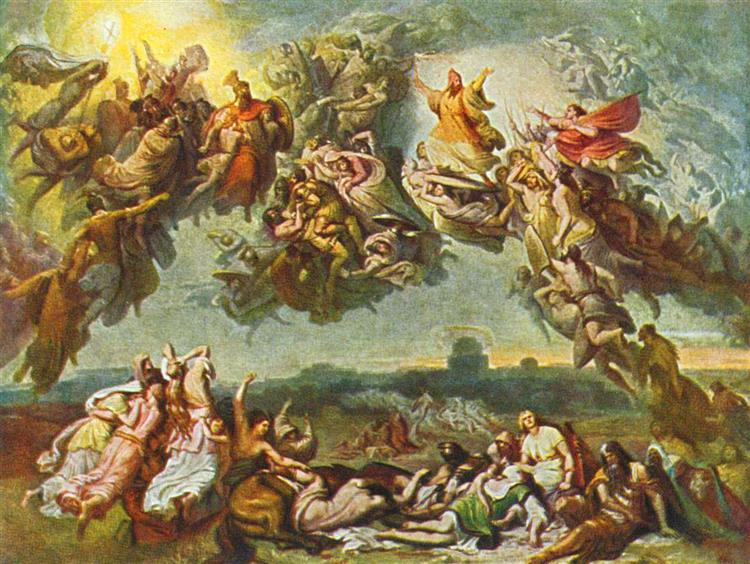
One of the six frescoes, Hunnenschlacht (The Battle of the Huns), was the inspiration for a symphonic poem by the Hungarian composer and pianist Franz Liszt (1811–1886). The subject of this painting was the fifth-century Catalaunian Fields battle in which Attila led the Hun armies against Roman and Visigoth armies. Legend has it that the souls of the dead warriors continued fighting in the sky because the battle was so fierce. Georg Predota wrote, “Liszt visited Kaulbach at his Munich studio around the end of 1856, and he immediately decided to ‘subject several of his historical works to musical transformation with the concept of the history of the world in music and images’. . . . The work was completed in 1857.”
Liszt creates an atmosphere of foreboding and ferocity from the opening notes of Hunnenschlacht. The battle begins in earnest in the second section; horns play a “battle cry” and the main battle theme is stated. During this section, Liszt included the so-called gypsy scale, a common device that he used in his Hungarian-themed works, and he also has the trombone section play “Crux fidelis,” an ancient plainchant melody, representing the cross.
Annie Liu wrote, “Liszt attempted to translate painterly figurations into music; this intention is particularly embodied in his symphonic transformation of Wilhelm Kaulbach’s monumental fresco, Hunnenschlacht. Liszt was attracted by the idea of religious devotion and at the same time identified himself with the Huns. . . . In Hunnenschlacht, he used the graphic illustration of the fresco as his primary source, yet he also attempted to convey the various tone colors associated with the figures. This interpretative process is explained in his preface to the score, in which Liszt describes the lights and colors associated with the Huns, the Romans, and the Cross. The peculiar treatment of instrumentation, including the use of wooden and sponge drum sticks, organ, unusual combinations of instruments, and an audacious treatment of dynamics, vibrantly depict the distinct colors or lights that envelop the principal figures in the painting.”
My classical music post for today is Franz Liszt: Hunnenschlacht.


Leave a Reply