

There are two categories of classical music that use visual art as the subject of the composition. “Inspired-by” music takes a work of art as a notional starting point, whereas “ekphrastic” music aims to comment on or illuminate the visual artwork. This November, the Daily Classical Music Post will explore music based on visual art from the Renaissance to the 21st century.
The American abstract painter Mark Rothko is best known for his color field paintings. His intent when painting these large works was to envelop the viewer within the work. He said, “I realize that historically the function of painting large pictures is painting something very grandiose and pompous. The reason I paint them, however . . . is precisely because I want to be very intimate and human. To paint a small picture is to place yourself outside your experience, to look upon an experience as a stereopticon view or with a reducing glass. However you paint the larger picture, you are in it. It isn’t something you command!” Although the majority of Rothko’s paintings were oil on canvas, towards the end of his life he switched to acrylic paint.
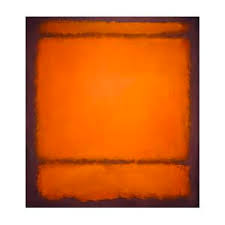
In 1960, Rothko painted No. 210/No. 211 (Orange). This abstract expressionist painting is made up of varying densities of orange paint over a purple foundation; the relationship between the variations is intended to elicit a spiritual response. Don Bacigalupi wrote, “This is a masterful painting. The palette of colors is remarkably vibrant and intense. The work absolutely radiates and draws you into it. It’s a superb example of Rothko’s mature period.”
The American composer Adam Schoenberg (born 1980) was commissioned in 2006 by the IRIS chamber orchestra to write a work. At that time, Schoenberg was studying composition at Juilliard, and he was inspired by the Rothko exhibits in the New York Museum of Modern Art when he took on this commission, his first professional one. Finding Rothko is in four movements: Orange; Yellow; Red; and Wine. Each movement is linked to the others via a three-chord motif, major tenth chords, that Schoenberg called “Rothko’s theme.”
Luke Howard wrote, “Finding Rothko doesn’t try to portray Rothko’s use of color and shape, or attempt to ‘set’ the paintings to music. The artworks are simply a pretext, an inspiration. Yet the choice of paintings and the color connections between them formed a narrative in the composer’s imagination that is expressed clearly in the music. ‘Orange’ opens with ‘Rothko’s theme’ and is somewhat atmospheric—a Copland-esque dawn, perhaps.” Pierre Ruhe wrote, “There’s a stillness in the first section, based on the painting ‘Orange,’ even with thumps from the percussion and a wavy violin line that seems to express the thin wavy lines scrawled on a blood red ‘belt’ that bisects the painting.”
My classical music post for today is Adam Schoenberg: Finding Rothko: Orange.


Leave a Reply