

There are two categories of classical music that use visual art as the subject of the composition. “Inspired-by” music takes a work of art as a notional starting point, whereas “ekphrastic” music aims to comment on or illuminate the visual artwork. This November, the Daily Classical Music Post will explore music based on visual art from the Renaissance to the 21st century.
Hindemith: Mathis der Maler Symphony: III. Versuchung des heiligen Antonius
Very little is known about the German Renaissance painter Matthias Grünewald. He was well regarded in his lifetime, but he was almost completely forgotten following his death in 1528 until the late 19th century. The majority of his works were lost at sea and only 10 paintings and 35 drawings survive. One of these surviving works, the Isenheim Altarpiece, was painted for the Monastery of St. Anthony. The monks operated a hospital, and Grünewald’s paintings for the altarpiece are particularly notable for the realistic depiction of wounds and medical conditions.
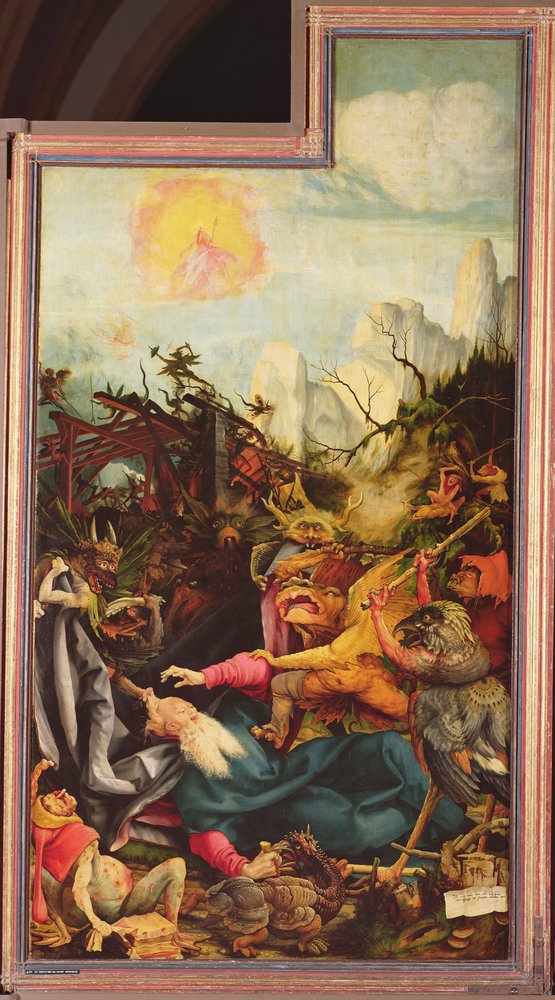
The painting on the right-hand inner wing of the altarpiece is of The Temptation of Saint Anthony. It depicts Saint Anthony surrounded by a horrifying group of demons. Lust and spiritual torment are among the temptations that Saint Anthony endures with great anguish.
The German composer Paul Hindemith (1895–1963) wrote an opera very loosely based on Grünewald’s life; the main inspiration for the opera was the Isenheim Altarpiece. Before he finished composing the opera, he took some of the music and refashioned it into a three-movement symphony, Mathis der Maler (1934). Although the premiere was a success, Hindemith’s anti-Nazi views soon led to a ban on any performance of the work in Germany. He left Germany not long after, mainly because the Nazis considered his music to be “degenerate and banned all of it.”
Howard Posner wrote, “Each movement of the Symphony is based on Grunewald’s vivid and sometimes grotesque and bizarre Isenheim altarpiece paintings. . . . The last movement is a wholly symphonic creation using music from the extended climactic scene in the opera, which is based on two of the Isenheim paintings. In one of them, St. Anthony is assailed by grotesque demons. . . . The other shows St. Anthony meeting St. Paul the Hermit. Shortly before the end of a movement of explosive force and great churning energy, the woodwinds introduce the 13th-century chant ‘Lauda Sion Salvatorem,’ which is answered by majestic alleluias in the brass.”
My classical music post for today is Paul Hindemith: Mathis der Maler Symphony, III. Versuchung des heiligen Antonius.


Leave a Reply