

There are two categories of classical music that use visual art as the subject of the composition. “Inspired-by” music takes a work of art as a notional starting point, whereas “ekphrastic” music aims to comment on or illuminate the visual artwork. This November, the Daily Classical Music Post will explore music based on visual art from the Renaissance to the 21st century.
Helen Grime – Two Eardley Pictures – 1. Catterline in Winter (World Première)
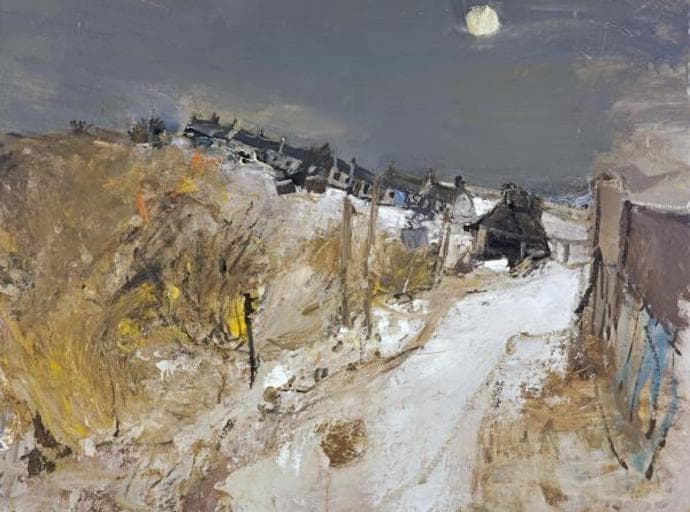
The Scottish artist Joan Eardley was particularly noted for her landscapes of the Scottish coast as well as her portraits of street children in Glasgow. She lived in Catterline, a village on the North Sea coast in Scotland, for several years, and many of her seascapes and landscapes are of that area. Eardley often would paint the same scene but at different times of the day or the year, or she would create works in different, sometimes stormy, weather conditions. She also occasionally included real pieces of vegetation, like grass or grit, in her paintings. She said, “When I’m painting in the North East, I hardly ever move out of the village (Catterline), I hardly ever move from one spot. I do feel the more you know something, the more you can get out of it.”
The Scottish composer Helen Grime (born 1981) was inspired by Eardley’s artworks and in 2016 composed Two Eardley Pictures to commissions by the BBC and by the National Youth Orchestra of Scotland. The piece won the prize for Large-Scale Composition at the Scottish Awards for New Music 2017. Grime said in an interview, “For me, the paintings are simply a starting point. I took certain basic ideas from them. In Catterline in Winter, you know how in the afternoon you have that wintry sun, that completely leaden sky? Well the piece is essentially dark, but these repeated moments keep coming back, much brighter, in a higher register, it’s like you’re constantly trying to get away from this heaviness.”
Claire Seymour wrote, “The precision, transparency and coloristic range of Grime’s score [Catterline in Winter] powerfully mimics the perspicacity of Eardley’s vision. The composer’s spacious use of register and the coolness of the timbres evoke the expanse of field and water, the chill of the finely etched vistas. But, one hears more particular pictorial images too: the swell of the ocean’s surge, the piercing chill of an icy blast, the rustle of reeds; and, aural references: the work incorporates a Scottish folksong, ‘The Scranky Black Farmer’. Grime has created a cavernous, echoing chamber suggestive of a primordial past, but she supplements this elemental boom with incisive brush-sweeps—piccolo whistles, pizzicato snaps, percussive chimes, a reedy plaint, a clarinet’s mellow wavering—which have a striking immediacy. There is a prevailing darkness and depth, until the increasingly vibrant, nasal brass seem to push first the woodwind and then the violins into their uppermost register, bringing crisp air and sharp light. The sun’s strength forcing aside the shadows.”
My classical music post for today is Helen Grime: Two Eardley Pictures, 1. Catterline in Winter.


Leave a Reply