

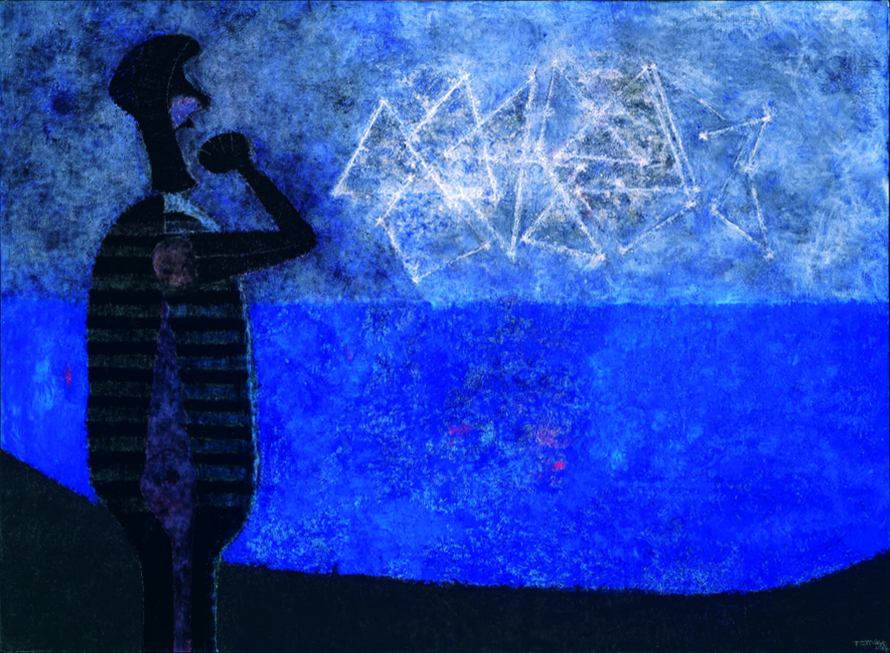
There are two categories of classical music that use visual art as the subject of the composition. “Inspired-by” music takes a work of art as a notional starting point, whereas “ekphrastic” music aims to comment on or illuminate the visual artwork. This November, the Daily Classical Music Post will explore music based on visual art from the Renaissance to the 21st century.
Pinturas de Tamayo: V. La gran galaxia (the Great Galaxy): Tranquillo
The Mexican Surrealist painter Rufino Tamayo did not agree with his contemporaries, particularly the muralists José Clemente Orozco, Diego Rivera, and David Alfaro Siqueiros, that art should be political and that revolution was necessary for the future of Mexico. Some of Tamayo’s work expressed this belief. He ended up leaving Mexico and moved to New York City and later to Paris, where he felt he could be free to paint what he wanted. He preferred to use only a few colours in his paintings; he said, “As the number of colours we use decreases, the wealth of possibilities increase.”
In 1978, Tamayo painted La gran galaxia, a striking work containing both fantastical and figurative forms. In this painting, a solitary figure stands in front of a cosmic scene containing contrasting dark and light tones. The viewer is encouraged to consider humanity’s place within the greater cosmos. The otherworldly quality of the painting is typical of Tamayo’s surrealist aesthetic.
The Pulitzer Prize–winning American composer Steven Stucky (1949−2016) composed everything from a cappella miniatures to large-scale orchestral works. His music is intricate, accessible, and imaginative, and often was described by critics as “beautiful.” In 1996, he was commissioned to write a work for the Chicago Symphony Orchestra, and he chose to honour Tamayo in Pinturas de Tamayo. There are five movements in this orchestral piece: 1. Amigas de los pájaros (Friends of the Birds); 2. Anochecer (Sunset); 3. Mujeres alcanzando la luna (Women Reaching for the Moon); 4. Músicas dormidas (Sleeping Musicians); and 5. La gran galaxia (The Great Galaxy).
Stucky wrote in the programme notes, “In April 1991 I visited the Rufino Tamayo Museum in Mexico City. I had never heard of Tamayo, but immediately I found myself drawn to his work, and I stood for a long while, transfixed by his painting La gran galaxia (The Great Galaxy). Indeed, that first encounter with his vibrant, mysterious, deeply human paintings is indelibly fixed in my memory as one of the great artistic experiences of my life.” Richard Whitehouse wrote, “A Chicago Symphony commission, Pinturas de Tamayo (1995) draws on the more tangible imagery of Mexican artist Rufino Tamayo, but the music for the most part is hardly less understated—witness the luminous poise of ‘Sunset’ or the rapt introspection of ‘The Great Galaxy’ which makes for an unusually thoughtful apotheosis.”
My classical music post for today is Steven Stucky: Pinturas de Tamayo: “La gran galaxia.”


Leave a Reply