

There are two categories of classical music that use visual art as the subject of the composition. “Inspired-by” music takes a work of art as a notional starting point, whereas “ekphrastic” music aims to comment on or illuminate the visual artwork. This November, the Daily Classical Music Post will explore music based on visual art from the Renaissance to the 21st century.
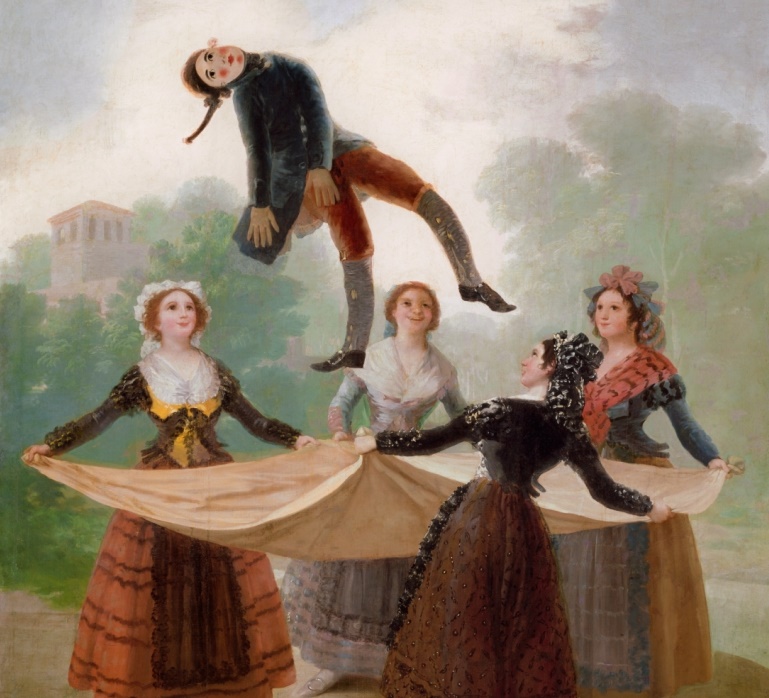
The Spanish Romantic painter Francisco de Goya was the most important Spanish artist in the late 18th and early 19th centuries. The subjects of his artworks included historical events and social and religious images. In 1791 and 1792, Goya painted a series of 267 tapestries for the private rooms of King Carlos IV. One of the canvases, El pelele, depicted a group of four women throwing a masked straw doll into the air on a stretched cloth. In Spain at that time, it was the custom to throw straw dolls like this one into the air on Ash Wednesday, and that is part of what Goya is depicting. But also, as Julia Kynast pointed out, “[T]he painter dealt here critically with the social issues of his time. In doing so, he thematizes through the depiction of the French-dressed doll, the French-oriented fashion infatuation of the Spanish royal court, as well as the power of women over the male figure.”
In 1911, the Spanish composer and pianist Enrique Granados (1867–1916) composed a set of six pieces, Goyescas, based on Goya’s paintings. The six pieces were published in two books: Book One has four pieces and Book Two has two pieces. El pelele: Escena goyesca (its full name) was composed as a standalone piece, but it is usually tacked on to the end of Book Two, making it the seventh piece in the suite. Goyescas was immediately successful, so much so that Granados expanded the piano suite into a one-act opera, also called Goyescas, which received its premiere in New York in 1916.
Walter Aaron Clark wrote, “The work is of great significance in Spanish music history, for unlike many of the nationalist creations of his contemporaries Isaac Albéniz, Manuel de Falla and Joaquín Turina, which drew their inspiration from Andalusia, Goyescas affirmed the enduring charm and cultural centrality of the city and region in which Goya spent most of his life: Madrid and Castile. . . . El pelele . . . is usually programmed along with the suite. The influence of Scarlatti is especially marked here, in the sheer delight Granados takes in sensual virtuosity and irrepressible bonhomie. . . . [T]he giddy exuberance of this music makes El pelele one of Granados’s most memorable compositions.”
My classical music post for today is Enrique Granados: El pelele: Escena goyesca.


Leave a Reply