

There are two categories of classical music that use visual art as the subject of the composition. “Inspired-by” music takes a work of art as a notional starting point, whereas “ekphrastic” music aims to comment on or illuminate the visual artwork. This November, the Daily Classical Music Post will explore music based on visual art from the Renaissance to the 21st century.
Walton: Portsmouth Point Overture
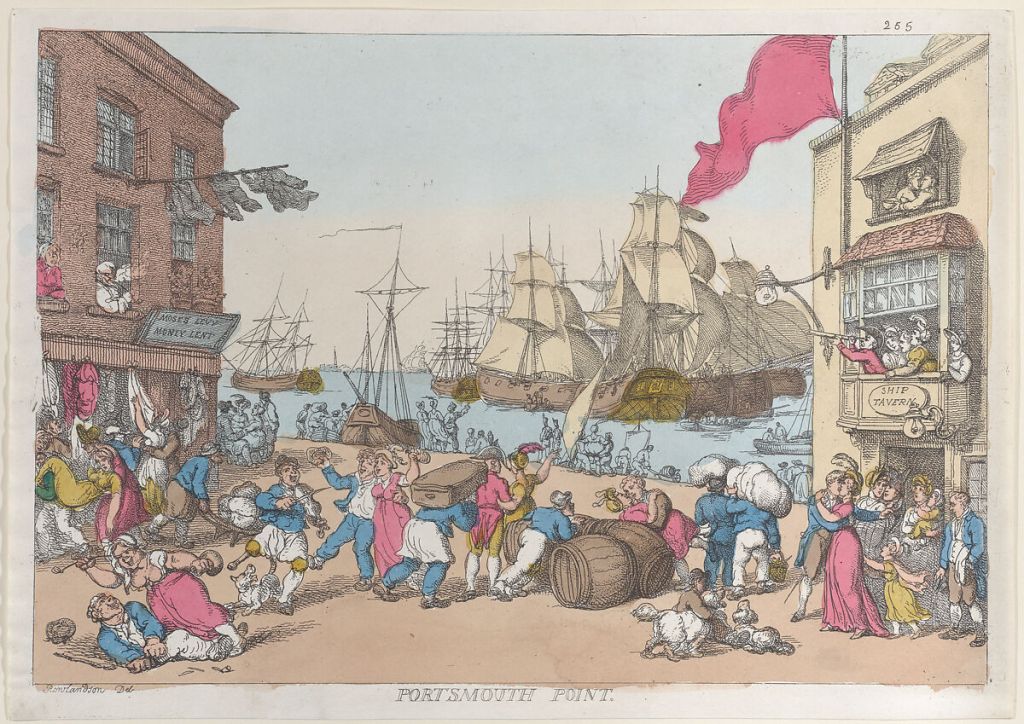
The prolific English artist and caricaturist Thomas Rowlandson was particularly noted for his political satire and observation of daily life. In 1814, he produced an etching of Portsmouth Point, a seedy area of Portsmouth Harbour in the south of England. This etching has all of the wonderful hallmarks of Rowlandson’s art: People are embracing or fighting and bustling about, ships are departing and arriving in the background, and it’s basically a chaotic scene depicting life in Regency-era England.
The English composer William Walton (1902–1983) was considered to be a Modernist until the 1950s, when his music was thought to be old-fashioned. His work has been re-evaluated, however, and he now is seen as one of the most important English composers of the 20th century. Malcolm Hayes wrote, “Many of Walton’s works amount to a richly inventive dialogue between two seemingly disparate musical impulses. First is a forward-looking modernist streak, with complex rhythms and jazz-inflected harmony. Alongside this is, though, is a deep vein of lyrical Romanticism, relating to his love of Elgar and Italian opera.”
In 1925, Walton was riding on a bus in London when the main musical idea for an orchestral work based on Rowlandson’s etching came into his mind. Portsmouth Point, an overture dedicated to the poet Siegfried Sassoon, shows the influence of the music of Igor Stravinsky as well as jazz elements in its lively depiction of the frenetic scene shown in the etching. Thomas Philbrick wrote, “This is a rambunctious piece, full of angularity and playful energy. I heard some Stravinsky in it, perhaps even a bit of jazz. One could be forgiven for seeing in its jaunty rhythms a precursor to the musical language of Aaron Copland.”
Nick Barnard wrote, “One of the very finest and most individual of [Walton’s] early bravura scores was Portsmouth Point. . . . This is a virtuosic score in every sense with the orchestration crammed with incident and overlapping musical material. A century after its composition it remains an absurdly confident and assured first major orchestral work to be written by a twenty-two year old.”
My classical music post for today is William Walton: Portsmouth Point.


Leave a Reply