

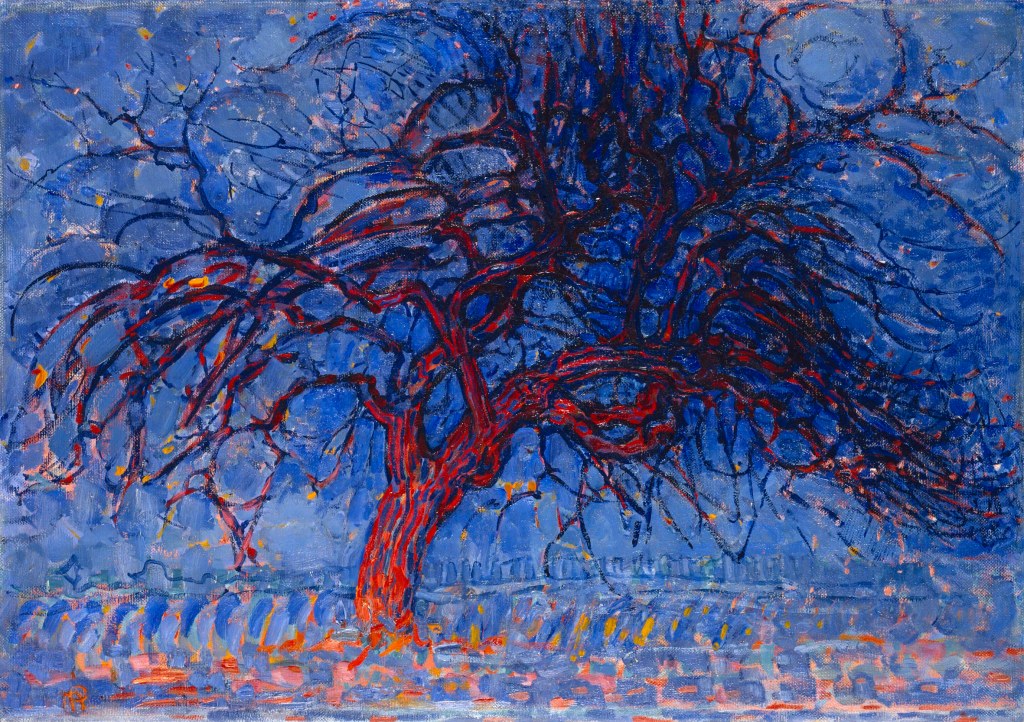
There are two categories of classical music that use visual art as the subject of the composition. “Inspired-by” music takes a work of art as a notional starting point, whereas “ekphrastic” music aims to comment on or illuminate the visual artwork. This November, the Daily Classical Music Post will explore music based on visual art from the Renaissance to the 21st century.
Mondrian Interiors: I. The Red Tree
The Dutch artist Piet Mondrian was one of the most important figures in the development of 20th-century abstract art. His early works were figurative and his first exhibitions displayed paintings that were Impressionist and mainly of landscapes. He soon began painting in a Post-Impressionist style, even, as in his 1908 painting Evening (Avond; also known as The Red Tree), emphasizing primary colours in a limited abstract way. It wasn’t long before he developed an avant-garde and nonrepresentational movement in art that he called Neoplasticism, and in his later paintings he reduced his artistic vocabulary to simple geometric elements and primary colours.
The Australian composer Stuart Greenbaum (born 1966) visited the Tate Gallery in London in 1997. He wrote in his programme notes, “I was pleased to find a special exhibition of the works of Dutch artist Piet Mondrian. It highlighted a fascinating development in his style from Symbolism and Cubism to the so-called Neo-Plasticism that he is most identified with today. On my way out, I bought picture cards of the works I liked most with the intention of setting them to music. They remained in their yellow paper bag for years. A decade later the idea came back to me and the cards (in chronological order) suggested the eight movements that comprise ‘Mondrian Interiors’. I don’t think it is essential to view the artworks in order to appreciate the music, but the comparison provides another level of interest. The eight movements are miniatures of varied length and scored either for the full ensemble, solo harp (which is featured) or other varied subsets that this sextet allows.”
The first movement of Mondrian Interiors (2007), “The Red Tree,” was inspired by Mondrian’s 1908 painting. Greenbaum uses the full ensemble to depict this artwork. Maureen Buja wrote, “In his setting of the image, as it were, Greenbaum immediately takes us to the urgency in the red colouring against the intense blue sky. The harp soloist is immediately a contrast to the held chords of the ensemble, seeming to scrabble up the increasingly smaller and smaller branches, until sliding back down again, and repeating the return upward.”
My classical music post for today is Stuart Greenbaum: Mondrian Interiors: I. The Red Tree.


Leave a Reply