

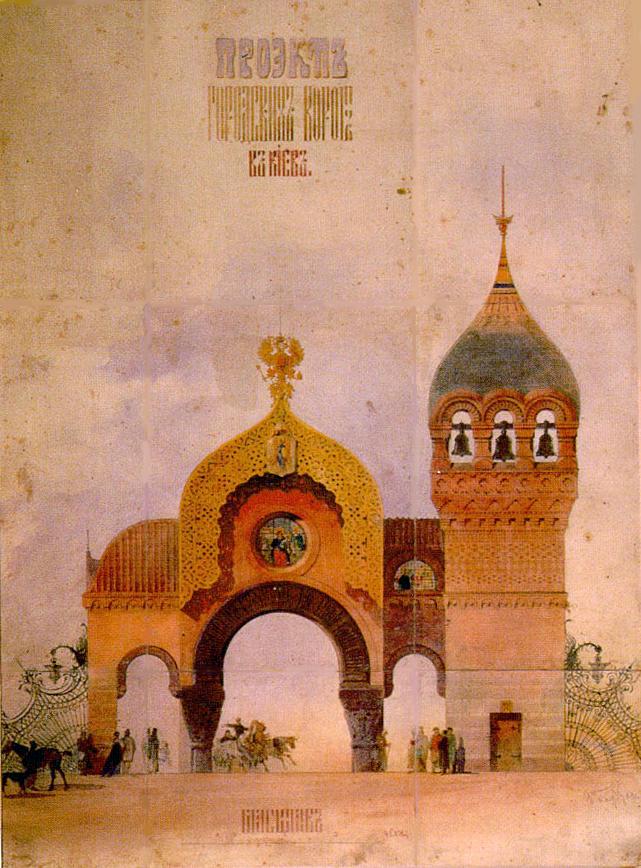
There are two categories of classical music that use visual art as the subject of the composition. “Inspired-by” music takes a work of art as a notional starting point, whereas “ekphrastic” music aims to comment on or illuminate the visual artwork. This November, the Daily Classical Music Post will explore music based on visual art from the Renaissance to the 21st century.
Mussorgsky – Pictures at an Exhibition (original piano version)
The entire Russian arts community was shocked when the painter and architect Viktor Hartmann died suddenly from an aneurysm. Hartmann was a champion of celebrating Russian culture through art, and many of his watercolours and sketches were design proposals for buildings that he hoped might be built in Russia and in European cities. Some of Hartmann’s art was immortalized by his close friend, Russian composer Modest Mussorgsky (1839–1881), who was inspired to channel his grief over Hartmann’s death into an extraordinary work for piano, Pictures at an Exhibition, commemorating the exhibition of over 400 of Hartmann’s paintings that was held in the Academy of Fine Arts in Saint Petersburg in 1874. Howard Posner wrote, “Of the 16 sections of Pictures at an Exhibition, . . . only six of the artworks exist today.”
Richard Friswell wrote, “Little known today is the fact that the full title of the work is Pictures from an Exhibition—A Remembrance of Viktor Hartmann, that the composition was not performed in Mussorgsky’s lifetime and that, today, the most popular and accurate version of his 10-movement piano work was arranged for orchestra in 1931. But, Mussorgsky’s motivation at the time of Hartmann’s death was to honor a friend and promote his reputation through music.”
Most people who know Maurice Ravel’s excellent and colourful orchestration of the original piano version most likely don’t know that there were at least three earlier orchestrations. Only one of these, by the Slovenian conductor Leo Funtek, included the entire piano piece. Today, Ravel’s is the orchestration most often performed, although many conductors make a few changes to Ravel’s version, so there really isn’t a definitive edition.
But none of these orchestrations really convey the raw emotion of the original piano work. Mussorgsky’s recounting through music of walking through the exhibition, stopping here and there in front of the paintings, leaves the listener in no doubt as to the deep loss that the composer felt. Pictures at an Exhibition is a masterpiece, perhaps one of Mussorgsky’s greatest compositions. This shows Mussorgsky at his most vulnerable but also at his most brilliant.
My classical music post for today is Modest Mussorgsky: Pictures at an Exhibition.


Leave a Reply