

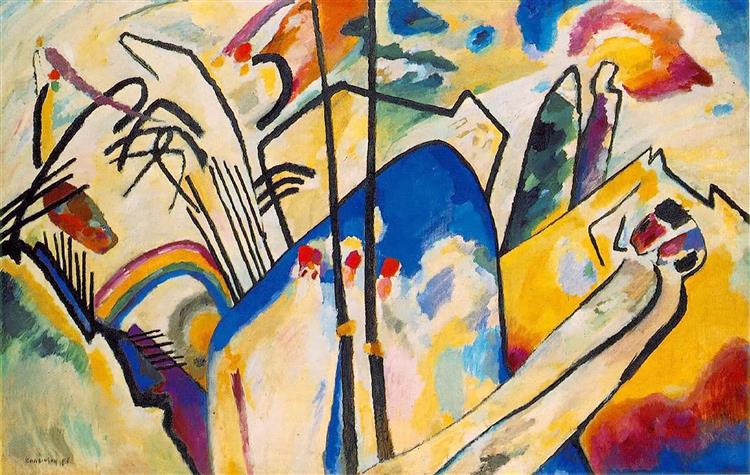
There are two categories of classical music that use visual art as the subject of the composition. “Inspired-by” music takes a work of art as a notional starting point, whereas “ekphrastic” music aims to comment on or illuminate the visual artwork. This November, the Daily Classical Music Post will explore music based on visual art from the Renaissance to the 21st century.
The Russian painter Wassily Kandinsky was a pioneer of abstract art. He saw connections among the arts, particularly between music and visual art: “Colour is the keyboard, the eyes are the harmony, the soul is the piano with many strings. The artist is the hand which plays, touching one key or another, to cause vibrations in the soul.”
During what is known as his Blue Rider Period, from 1911 to 1914, the synesthetic Kandinsky created large, colourful abstract paintings; he sometimes referred to these as “compositions,” again connecting the visual with music. His oil painting Composition IV, completed in 1911, is one of the first of these works. An interesting, and perhaps apocryphal, story about this painting reveals how Kandinsky developed abstraction in art. Apparently, he was tired after everything he put into the preparation and execution of the painting, and so he left his studio and went for a walk. His assistant was tidying the studio and when putting Composition IV away he turned it on its side. Kandinsky returned, saw the canvas, had a “Eureka!” moment, and the direction of his art and life was changed forever.
The British composer Philip Sawyers (born 1951) has composed works for orchestra and chamber ensemble, mostly traditional in form and usually programmatic. In 2006, Sawyers visited a Kandinsky exhibition at Tate Modern in London and was moved to compose the symphonic poem Hommage to Kandinsky (completed in 2013); he said, “I have seldom been so excited and involved with a display of visual work in its entirety. Thus the urge to write a piece which reflected my feeling about his paintings was born.”
Although none of Kandinsky’s paintings are specifically mentioned in the score, Sawyers said, “I deliberately created a musical theme following the ‘lines’ in ‘Composition IV’ of 1911, a bit like a graphic score. This idea first appears in the cellos and basses very near the start of the piece.” Richard Whitehouse wrote, “Structurally the piece unfolds through alternating passages of relative stasis and motion, and if slower sections predominate as it progresses, there is never a risk of expressive inertia owing to the deftness with which existing motifs take on greater intensity while timbral and textural aspects are enriched accordingly.”
My classical music post for today is Philip Sawyers: Hommage to Kandinsky.


Leave a Reply