

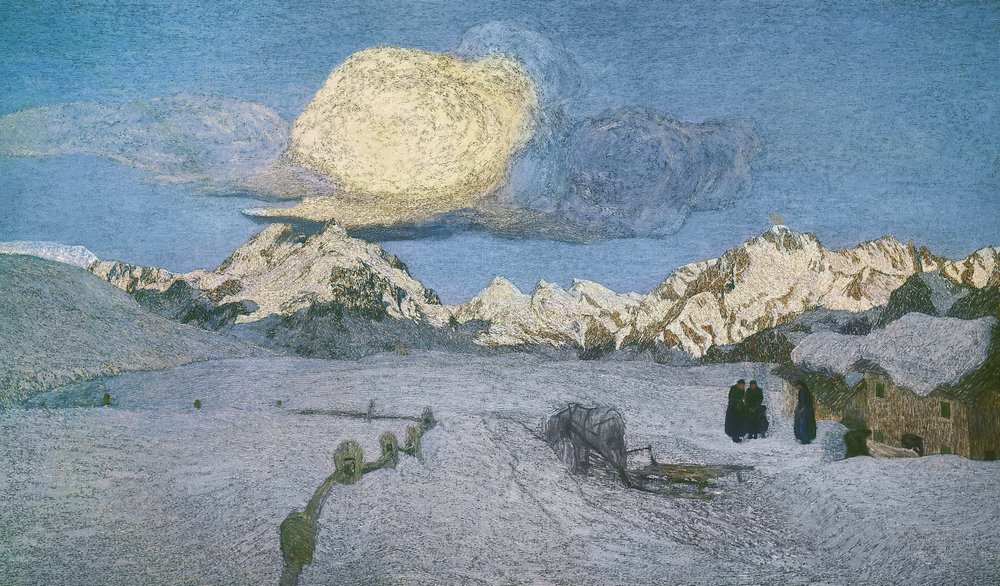
There are two categories of classical music that use visual art as the subject of the composition. “Inspired-by” music takes a work of art as a notional starting point, whereas “ekphrastic” music aims to comment on or illuminate the visual artwork. This November, the Daily Classical Music Post will explore music based on visual art from the Renaissance to the 21st century.
The Italian-Austrian painter Giovanni Segantini was known for his large-scale Alpine landscapes. His artworks combined the Divisionist style with Symbolist views of nature. His Alpine Triptych was commissioned for the 1900 Exposition Universelle in Paris. The three large panels were the last paintings he worked on before his death in 1899. The three paintings, Life (La Vita), Nature (La Natura), and Death (La Mort), were meant to be part of a larger group of 12 paintings, with an additional three allegorical lunettes and six small medallions representing other Alpine subjects. The Getty Museum website says that in these paintings Segantini “combines all the elements that distinguish [his] best mature work: an Alpine landscape rendered precisely and at monumental scale; a peasant protagonist treated with quiet reverence; and a fine graphic sense, with color applied in parallel strokes.”
The Austrian composer Anton Webern (1883–1945) composed a number of works in a Late Romantic style before he began his studies with Arnold Schoenberg in 1904, and even though his music became more abstract after a few years, he never lost the lyricism, intimacy, and nostalgia of his earlier output. Webern disowned much of what he composed before he studied with Schoenberg, but some of these works were discovered and published posthumously, including today’s selection.
Webern was a great fan of Segantini. He wrote, “I long for an artist in music such as Segantini was in painting . . . far away from all turmoil of the world, in contemplation of the glaciers, of eternal ice and snow, of the sombre mountain giants. . . . [A]n alpine storm, . . . the radiance of the summer sun on flower-covered meadows—all these would have to be in the music, born … of alpine solitude. That man would then be the Beethoven of our day.” In 1905, Webern composed a string quartet that he said was inspired by Segantini’s Alpine Triptych.
Although the string quartet is in one movement, there are three distinct sections, corresponding to Segantini’s paintings. Eric Frederick Jensen wrote, “The String Quartet begun by Webern in summer 1905 is prefaced by the German titles of Segantini’s triptych: ‘Werden—Sein—Vergehen’. . . . Writing in 1967, Edward Cone felt that the quartet was ‘on the verge of the cellular construction that helps hold together many of the early atonal compositions’. Others have pointed out atonal sections within the work itself, several years before Schoenberg adopted a similar approach.”
My classical music post for today is Anton Webern: String Quartet (1905).


Leave a Reply