

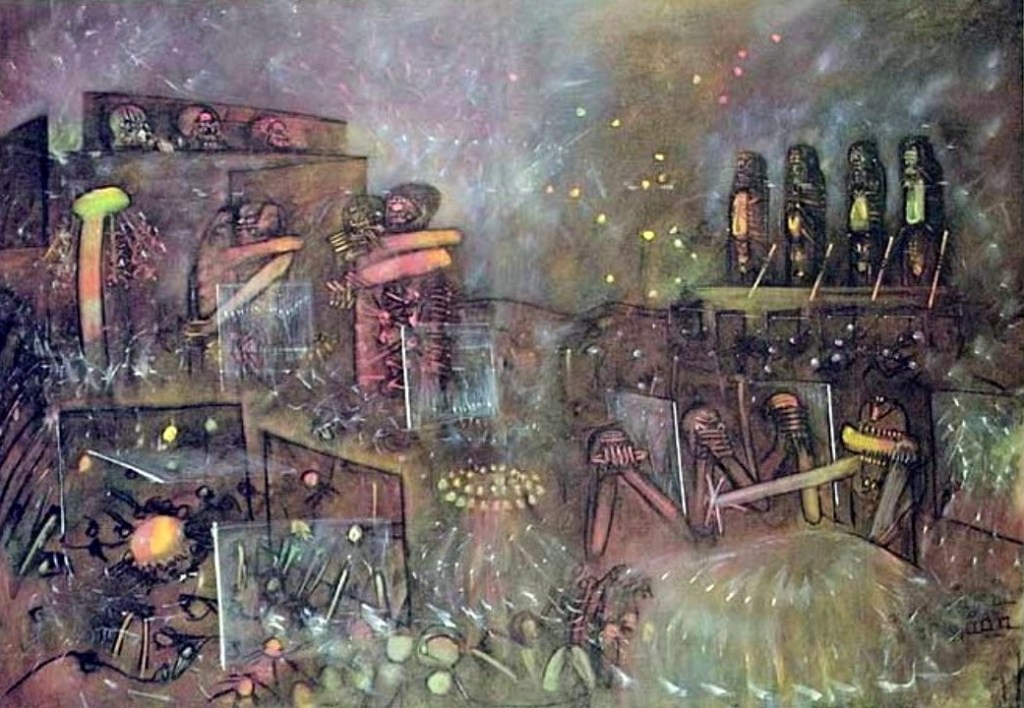
There are two categories of classical music that use visual art as the subject of the composition. “Inspired-by” music takes a work of art as a notional starting point, whereas “ekphrastic” music aims to comment on or illuminate the visual artwork. This November, the Daily Classical Music Post will explore music based on visual art from the Renaissance to the 21st century.
Richard Barrett : Ne songe plus à fuir (1985-1986)
The Chilean painter Roberto Matta was a seminal figure in 20th-century abstract expressionist and surrealist art. Matta’s works fall into distinct periods; in the 1940s and 1950s, the world of politics was a major subject of Matta’s art. His paintings were filled with depictions of electrical machinery and distressed or agitated figures. It was during this time that Matta painted Ne songe plus à fuir (“Dream no more of fleeing”; 1951), his response to the Pinochet regime. Matta strongly believed in art as an agent for social and political change. Ne songe plus à fuir is an example of Matta’s post-Surrealist, semi-abstract style, incorporating biomorphic shapes and cosmic imagery.
The Welsh composer Richard Barrett (born 1959) is known for his complex and often densely textured atonal music. His work frequently explores themes of fragmentation, transformation, and the interplay between acoustic and electronic sounds. Barrett often includes quotes from the works of Samuel Beckett in his manuscripts. Bill Shoemaker wrote, “[Richard] Toop oddly points to an ‘element of violence’ in the work of artists who influenced Barrett’s early works, including Chilean surrealist painter Roberto Matta, as well as Beckett. The inspiration for Barrett’s then-new solo cello piece, Matta’s Ne songe plus à fuir, depicts anguished, terrorized figures in a dark scape, an outraged response to the murderously repressive Pinochet regime.” Ne songe plus à fuir was composed in 1986 and was one of Barrett’s earliest works to experiment with the structure of the cello and how the player could interact with the instrument.
Richard Whitehouse wrote, “Richard Barrett makes demands on the listener only proportionately less than on the performer, but his music is worth the attention of anyone who believes that sound is a living entity in itself rather than merely an expressive ‘given’. . . . Ne songe plus à fuir (‘Dream no more of fleeing’) ruthlessly yet methodically dissects the cello’s sound world.” Catherine Laws wrote, “Ne songe plus à fuir . . . is one of Barrett’s most successful pieces to date. . . . Barrett prefaces the score with a quotation from Beckett’s Molloy (‘Stories [. . .] I have not been able to tell them. I shall not be able to tell this one’). . . . The performance details state that each bar should be played as if taking place in a single breath; . . . the effect is reminiscent of Beckett’s How It Is.”
My classical music post for today is Richard Barrett: Ne songe plus à fuir.


Leave a Reply