

There are two categories of classical music that use visual art as the subject of the composition. “Inspired-by” music takes a work of art as a notional starting point, whereas “ekphrastic” music aims to comment on or illuminate the visual artwork. This November, the Daily Classical Music Post will explore music based on visual art from the Renaissance to the 21st century.
Four Tone Poems after Arnold Böcklin, Op. 128: I. Der geigende Eremit
The Swiss Symbolist painter Arnold Böcklin often explored themes of death and mortality in his artworks through religious or mythological subjects. His reputation suffered in the early part of the 20th century, but he was greatly admired by the Surrealists, including Max Ernst and Salvador Dalí, and by the 1960s his paintings were rediscovered and admired. His most famous works are the five Isle of the Dead paintings, created between 1880 and 1886. Several Romantic composers were inspired by the Isle of the Dead paintings as well as other Böcklin artworks.
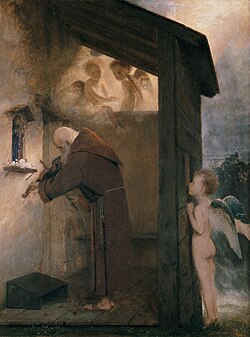
The German composer Max Reger (1873–1916) was mostly known for his organ music and lieder, although many of his later works were written for orchestra. In 1913, Reger composed Vier Tondichtungen nach A. Böcklin (Four Tone Poems After Arnold Böcklin), Op. 128, inspired by the paintings Der Einsiedler, Im Spiel der Wellen, Die Toteninsel, and Bacchantenfest. Böcklin painted Der Einsiedler in Florence in 1884. It depicts a hermit monk playing a violin for a small image of the Virgin Mary and the Christ child (often described as angels or “heavenly children”) in a grotto. “Der geigende Eremit” is the first movement of Reger’s music. A solo violin, representing the hermit fiddler, plays against two groups of strings, one muted and the other not muted, and the rest of the orchestra.
Chanda VanderHart wrote, “Reger’s hermit is alone, but not necessarily lonely—the movement is rich with lush beauty and just a touch of the melancholy.” Programme notes from a Hollywood Bowl concert said, “The tone of ‘Hermit Fiddler’ is one of quiet longing. In Böcklin’s work, an old man in robes performs alone at a shrine of the Madonna while curious cherubim look on. Reger’s hermit—solo violin—voices a reverent melody that is answered by the woodwinds and carried over richly sonorous chords in the strings.”
My classical music post for today is Max Reger: Vier Tondichtungen nach A. Böcklin: “Der geigende Eremit.”


Leave a Reply