

There are two categories of classical music that use visual art as the subject of the composition. “Inspired-by” music takes a work of art as a notional starting point, whereas “ekphrastic” music aims to comment on or illuminate the visual artwork. This November, the Daily Classical Music Post will explore music based on visual art from the Renaissance to the 21st century.
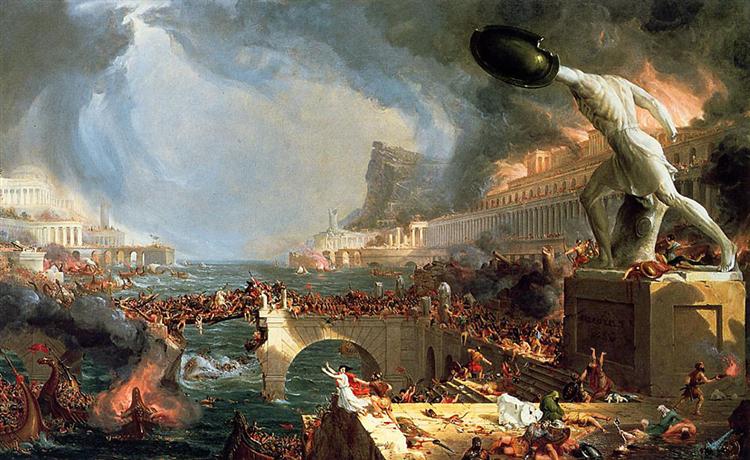
The course of Empire: Destruction
The American artist Thomas Cole was the founder of the Hudson River School in New York in the mid-19th century. He also created allegorical works; the most well-known of these is The Course of Empire, a series of five oil paintings that he worked on between 1833 and 1836. This series, all containing the same background landscape, shows the progression of empire: The Savage State, The Acadian or Pastoral State, The Consummation of Empire, Destruction, and Desolation. Cole’s inspiration came from Lord Byron’s Childe Harold’s Pilgrimage, Canto IV: “First freedom and then Glory—when that fails, / Wealth, vice, corruption . . .”
Maureen Buja wrote, “Destruction shows the city under siege, fire in the upper right, and destruction of the beautiful stonework at the bottom right. We are at the same point of view as in the previous picture, later in the day. Green banners on the temple side contest red banners on the palace site. A woman in white jumps to her death as a soldier vainly catches at her cloak; another weeps over her dead child. The lower left is filled with dragon-headed boats filled with soldiers. Above it all, the mountain stands.”
The American composer Nell Shaw Cohen (born 1988) saw Cole’s The Course of Empire at the New-York Historical Society in 2008 and was immediately inspired to compose a string quartet. Cohen said in an interview, “In particular, the evolution of the landscape and its moods shown through weather and light spoke to me as a kind of universal, almost abstract, narrative that would translate very well into music. Cole’s combination of epic scale with detail and nuance is of course very engaging to the eye; and the imagery is incredibly bold, dynamic, striking. There’s a lot there to respond to.”
The fourth movement of Cohen’s string quartet, “Destruction,” is (as she described it) “Bartók meets Led Zeppelin.” Cole’s paintings depict a mountain in the upper right, and Cole includes a “mountain motif” in each movement; in “Destruction,” it is heard in the ragged and violent opening notes.
My classical music post for today is Nell Shaw Cohen: The Course of Empire, IV. Destruction.


Leave a Reply