

There are two categories of classical music that use visual art as the subject of the composition. “Inspired-by” music takes a work of art as a notional starting point, whereas “ekphrastic” music aims to comment on or illuminate the visual artwork. This November, the Daily Classical Music Post will explore music based on visual art from the Renaissance to the 21st century.
Trittico Botticelliano: I. Spring
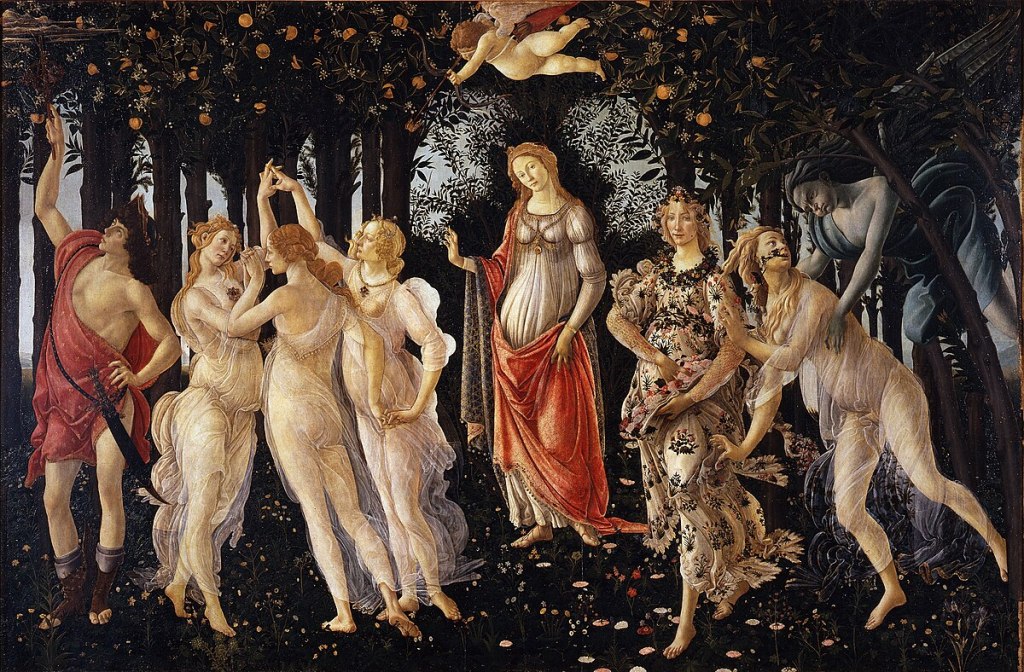
The Italian Renaissance master Sandro Botticelli painted religious figures and portraits, but it is for his paintings of mythological subjects that he is best known, particularly La primavera (Spring) and La nascita di Venere (The Birth of Venus). Both of these works were created some time in the late 1470s or early 1480s. Although his most successful and well-known art dates mostly from the Late Renaissance period, his works represent late Italian Gothic or Early Renaissance styles. He was largely forgotten after his death until the late 19th century, when he was rediscovered by the Pre-Raphaelites.
La primavera, alternatively referred to as “one of the most popular paintings in Western art” and “one of the most controversial paintings in the world,” features six female and two male figures along with Cupid. The elaborate scenery is reminiscent of a Flemish tapestry. The viewer can see the season of Spring progressing from left to right, and some critics also have described the painting as “an elaborate mythological allegory of the burgeoning fertility of the world.”
The Italian composer Ottorino Respighi (1879–1936) drew inspiration for his three-movement suite Trittico Botticelliano (“Three Botticelli Pictures”) from La primavera, L’adorazione dei Magi, and La nascita di Venere. Respighi composed this orchestral suite in 1927 following a visit to the Uffizi in Florence. Ivan March wrote that Respighi “bewitchingly realized” the Botticelli paintings, in particular noting the “luscious trills of springtime birdsong.”
Salvatore Di Vittorio wrote, “Trittico botticelliano was dedicated to Elizabeth Sprague Coolidge, a patron also of such composers as Ravel and Bartók. . . . Under the patronage of Mrs Coolidge, the world première was held on 28 September 1927 at the Konzerthaus in Vienna, under the direction of the composer. The first movement, La Primavera (Spring), is full of effects characteristic of Respighi, with its trills and rich sonorities. It continues with horn and trumpet calls and music that introduces typical dance rhythms.”
My classical music post for today is Ottorino Respighi: Trittico Botticelliano: La primavera.


Leave a Reply