

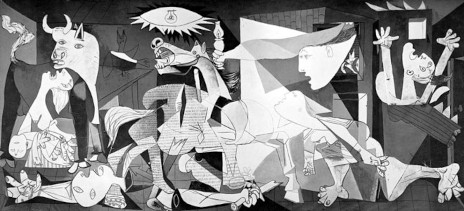
There are two categories of classical music that use visual art as the subject of the composition. “Inspired-by” music takes a work of art as a notional starting point, whereas “ekphrastic” music aims to comment on or illuminate the visual artwork. This November, the Daily Classical Music Post will explore music based on visual art from the Renaissance to the 21st century.
The Spanish artist Pablo Picasso created his masterpiece Guernica in response to the bombing of the town of Guernica by German and Italian warplanes at the behest of the Spanish Nationalist forces, on 26 April 1937, during the Spanish Civil War. The Spanish Republican government commissioned Picasso to create a large mural for the Spanish display at the Paris International Exposition at the 1937 World’s Fair in Paris. Once it was completed, it was displayed around the world. This tour helped bring the Spanish Civil War to the world’s attention. Picasso had not wanted the painting to be returned until Spain was restored to a republic; he stipulated this in his will, along with other conditions, including the restoration of “public liberties and democratic institutions.”
A description of the painting on pablopicasso.org says, “Guernica shows the tragedies of war and the suffering it inflicts upon individuals, particularly innocent civilians. This work has gained a monumental status, becoming a perpetual reminder of the tragedies of war, an anti-war symbol, and an embodiment of peace. . . . This work is seen as an amalgamation of pastoral and epic styles. The discarding of color intensifies the drama, producing a reportage quality as in a photographic record. Guernica is blue, black and white, 3.5 meters (11 ft) tall and 7.8 meters (25.6 ft) wide, a mural-size canvas painted in oil. . . . Some critics warn against trusting the political message in Guernica. For instance, the rampaging bull, a major motif of destruction here, has previously figured, whether as a bull or Minotaur, as Picasso’s ego. However, in this instance the bull probably represents the onslaught of Fascism. Picasso said it meant brutality and darkness. He also stated that the horse represented the people of Guernica.”
The Spanish composer Leonardo Balada (born 1933) was inspired by Picasso’s painting to compose the orchestral piece Guernica in 1966. Hubert Culot wrote, “[Guernica] was written as a reaction to the pitiless bombing of that small Spanish town during the Civil War and a protest piece against wars; when it was composed the Vietnam War was still raging. So, the piece, that also signalled an important re-orientation of Balada’s musical thinking, from well-behaved neo-classicism to a more violent and radical form of Expressionism, has all one may expect of a work inspired by one of the most brutal and futile slaughters in Spanish history.”
My classical music post for today is Leonardo Balada: Guernica.


Leave a Reply