

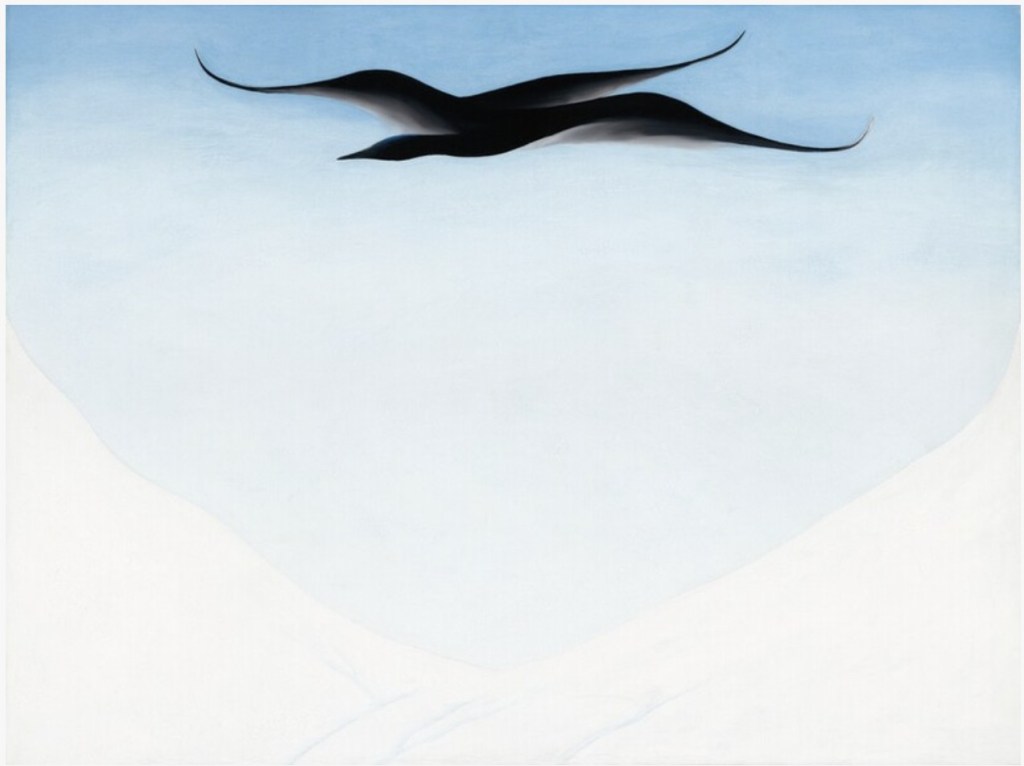
There are two categories of classical music that use visual art as the subject of the composition. “Inspired-by” music takes a work of art as a notional starting point, whereas “ekphrastic” music aims to comment on or illuminate the visual artwork. This November, the Daily Classical Music Post will explore music based on visual art from the Renaissance to the 21st century.
Libby Larsen: Black Birds, Red Hills, Movement 4, A Black Bird With Snow Covered Hills
The American artist Georgia O’Keeffe was best known for her paintings of the American Southwest, and particularly of Northern New Mexico. She was one of America’s most important painters, especially notable for her contribution to a field dominated by men. O’Keeffe’s 1946 painting A Black Bird with Snow-Covered Hills was the inspiration for Movement IV: A Black Bird with Snow-Covered Hills, from Black Birds, Red Hills (1996), by the American composer Libby Larsen (born 1950).
Larsen wrote in her programme notes: “Georgia O’Keeffe found the flow of time and color in music inspiring to her work as a painter. Black Birds, Red Hills is inspired by six paintings of Georgia O’Keeffe. Each painting explores the flow of time and color on her beloved red hills of New Mexico. In each painting O’Keeffe reveals perspective, beauty and meaning through the magnification of objects, specifically the horizon line, the black rock and the black bird. Movements I, III, and IV reflect the ‘V shape’ of the hills just outside O’Keeffe’s window. She describes this shape as the arms of two great hills, which reach out to the sky and hold it, suggesting to me an abstract cradle. In movement II, I liken the music to O’Keeffe’s image of the black rocks. O’Keeffe found these rocks on her walks to the Glen Canyon dam. She became fascinated with the effect of time on the rocks, noting that time has turned them into objects which are precious to look at and hold. Finally, to paint the black birds which lived in the hills near her, O’Keeffe covered the red hills with snow and focussed on the bird as a metaphor for time, always there and always moving away.”
Jeff Perkins wrote, “Libby Larsen’s excellent ‘Black Birds, Red Hills: A Portrait of Six Paintings of Georgia O’Keeffe (1887–1986) for B-flat Clarinet, Viola and Piano’ . . . is a beautifully constructed piece which captures the painter’s fascination with the effects of time.”
My classical music post for today is Libby Larsen: Black Birds, Red Hills IV: A Black Bird with Snow-Covered Hills.


Leave a Reply