

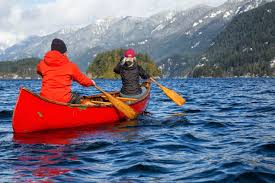
Music is a journey, taking listeners on an emotional and sometimes adventurous sonic path through time to new places both physical and spiritual. Some composers have chosen actual methods of transportation as their theme for this excursion. This October, the Daily Classical Music Post will feature music celebrating methods of transportation, from the land to the sea to the air.
Canadian Overture “Bewitched Canoe” – “La Chasse Galerie” by Airat Ichmouratov | 2023
No one is absolutely sure where the word “canoe” came from. Some say it dates from 1493 when the Taino word “kanawa” became “canoa” in Spanish. Others point to North American indigenous origins, for example in 1535 when French explorers translated a Saint-Lawrence Iroquoian word that became “casnouey.” The latter term was changed to “canoe” by English explorers. But wherever the word came from, canoes have been used for transportation since ancient times. Canoes and the related kayaks are popular in recreation, sporting events, and travel.
Canoes are closely associated with French Canadian culture, as evidenced by the popular tale La Chasse-galerie (known as “The Bewitched Canoe” or “The Flying Canoe”). This legend tells the story of some lumberjacks who were unable to travel home by water because the rivers were frozen. They make a deal with the devil and are given a canoe that can fly through the air. They are warned that if they speak God’s name or touch the steeple of a church, the devil will claim their souls.
The Russian Canadian composer Airat Ichmouratov (born 1973) has been described as a neo-romantic composer. He said in an interview, “My music is the best way to express what I feel in my heart. It is an emotion that I transform into a language understood all over the world.” Many of his compositions include the history and folk music of Quebec, where he has lived since the late 1990s.
Ichmouratov was inspired by the legend to compose his orchestral overture “The Bewitched Canoe” (2021). As with many of his works, “The Bewitched Canoe” communicates the story well and is an engaging and expressive work. The most obvious borrowing from French Canadian folk music is near the beginning of the overture, with the tune “Alouette” heard in the trumpet. Frédéric Cardin wrote that Ichmouratov’s music is “rich in cushioned harmonies and orchestral moiré.”
My classical music post for today is Airat Ichmouratov: “The Bewitched Canoe.”


Leave a Reply