

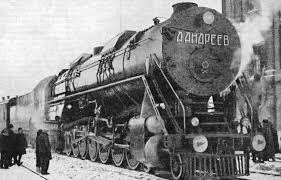
Music is a journey, taking listeners on an emotional and sometimes adventurous sonic path through time to new places both physical and spiritual. Some composers have chosen actual methods of transportation as their theme for this excursion. This October, the Daily Classical Music Post will feature music celebrating methods of transportation, from the land to the sea to the air.
Train travel in 1920s Russia was a challenging experience, mostly due to the lingering effects of the Civil War, the vastness of the country, and the beginnings of Soviet industrialization. Travel was relatively comfortable for military and political passengers, but for ordinary civilians, it was often basic and crowded. Journeys on freight-oriented trains, called “teplushkas,” were extremely uncomfortable. The rails could be bumpy and sleep was often disturbed. There was only a basic toilet and sink available at the end of the carriage.
It isn’t very easy to find much information online about the Russian composer Vladimir Deshevov (1889–1955). In the 1920s, it seemed that he was going to be one of the shining stars of Soviet music, but his music soon was considered too avant-garde for the Soviet establishment. By the 1940s, he was largely forgotten. Julian Grant wrote, “Most of his music has disappeared, though he himself survived the transition to Stalin’s ultra-reactionary regime relatively unscathed, by returning to the conservatism of his youth.”
Deshevov composed Rails in 1926. This short percussive, repetitive, motoric piano piece was actually an excerpt from one of his larger theatre scores. Pauly F. de Castro wrote, “Honegger’s Pacific 231 seems to have triggered a flurry of imitations among Russian composers, among which Vladimir Deshevov’s emblematic piano piece Relsy (Rails) op. 16 stands out. In fact, Relsy was itself a spin-off of the incidental music to Boris Paparigopulo’s stage adaptation of the novel Le Rail (1912), by French ‘proletarian’ writer Pierre Hamp (nom de plume of Henri Bourrillon). Its Leningrad premiere, on 18 May 1926, took place just a few months after the Russian premiere of Honegger’s work.”
Orest Tsekhnovitser wrote, “What is closer to the proletariat, the pessimism of Tchaikovsky, and the false heroics of Beethoven, a century out of date, or the precise rhythms and excitement of Deshevov’s Rails? During the playing of Beethoven, the workers were utterly bored and patiently waited for the music to end. But contemporary Soviet compositions aroused contagious emotion among the audience. Proletarian masses, for whom machine oil is mother’s milk, have a right to demand music consonant with our epoch, not the music of the bourgeois salon, which belongs in the era of the horse and buggy and of Stephenson’s early locomotive.”
My classical music post for today is Vladimir Deshevov: Rails.


Leave a Reply