

Music is a journey, taking listeners on an emotional and sometimes adventurous sonic path through time to new places both physical and spiritual. Some composers have chosen actual methods of transportation as their theme for this excursion. This October, the Daily Classical Music Post will feature music celebrating methods of transportation, from the land to the sea to the air.
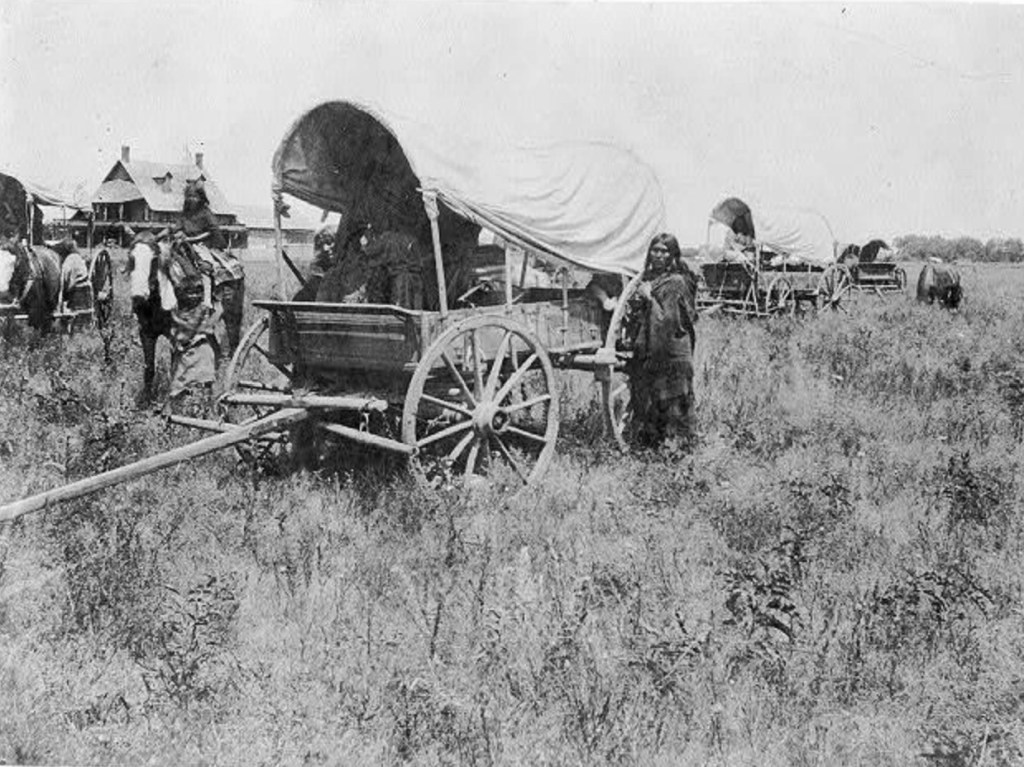
Covered wagons are horse- or ox-drawn wagons used for passengers or freight hauling. They were the main form of transportation for people moving west in the USA and Canada. As colonists from the east moved across the continent, they encountered the people who were already living there, leading to conflict. Covered wagons are, on the one hand, symbols of exploration, resilience, and the “American spirit” and, on the other hand, symbols of racism, offensive attitudes, and killing.
The Indigenous composer Brent Michael Davids (born 1959) addressed this conflict in his choral work The Un-Covered Wagon, commissioned by Chanticleer in 2003. In his extensive programme notes, Davids wrote, “The Un-Covered Wagon is sung entirely in Mohican with American Indian ‘vocables’ and tells of the existential reciprocity Indians have with the earth: ‘You Earth make us, We People make you, We all live here, Always, Ever.’ One of the first epic Western films, ‘The Covered Wagon,’ portrays the pioneers crossing what they saw as an open territory free-for-the-taking. But obviously, there were other people already living here—The Indians. How one-sided this American expansion is portrayed, not only for the old B/W era, but in today’s America too. America creates and sustains a legacy of trampling across the continent for its own uses. The Un-Covered Wagon uncovers an alternate view of America—it was never empty nor free-for-the-taking at all. The American continent has always been filled with others, people, and history, and has been known as intimately as a familiar footpath shared daily by humans and animals alike—long before America existed. To reveal this musically, a racist hymn occurs one half-step apart in tuning from an Indian background to create a new reality; the effect of this difficult passage is spooky and surreal. The end of the work calls for three different Indian singing styles to be superimposed upon each other. The Un-Covered Wagon, as music and message, urges us to reconsider the seasoned and intelligent tradition of keeping good familial relationships with the earth—that may in fact suit us better—and to finally strip that outdated chuck wagon called progress. Life is for sharing, not controlling.”
A review in The Times said, “In his piece, a self-righteous settlers’ hymn is overwhelmed by an exuberant fantasia of native chants, nose-flutes and whooping. It’s as if an alternative panorama of America is being unfurled aurally. Provocative stuff, thoughtfully conceived in multi-choral terms.”
My classical music post for today is Brent Michael Davids: The Un-Covered Wagon.


Leave a Reply