

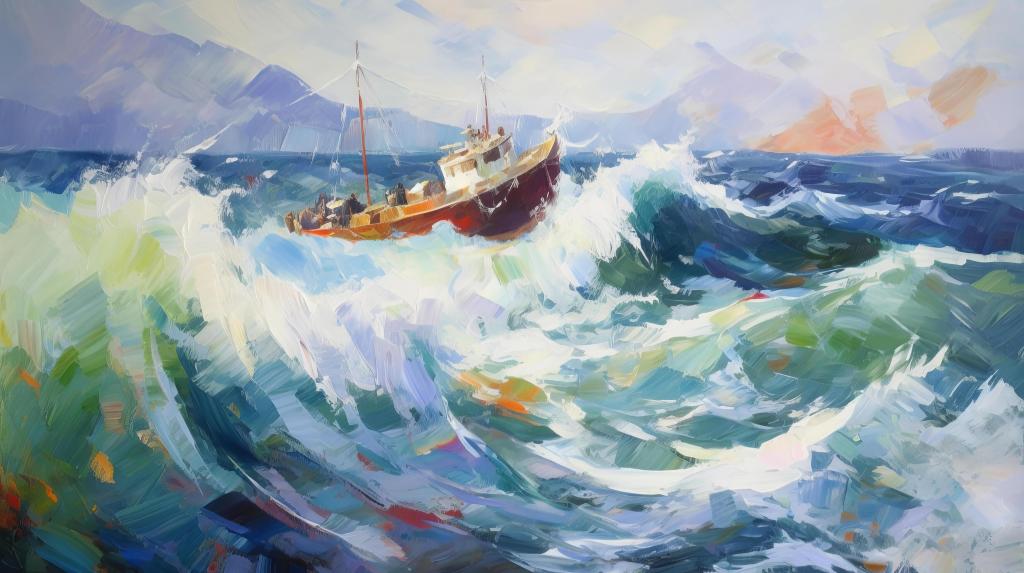
Music is a journey, taking listeners on an emotional and sometimes adventurous sonic path through time to new places both physical and spiritual. Some composers have chosen actual methods of transportation as their theme for this excursion. This October, the Daily Classical Music Post will feature music celebrating methods of transportation, from the land to the sea to the air.
Miroirs: III. Une barque sur l’océan
Just over 70 percent of the Earth’s surface is covered by water, so it isn’t surprising that boats became an extremely important and popular method of travel. As boats got bigger, people could travel farther not just for trading and business but also for recreation and tourism. In the late 19th and early 20th centuries, people would take a cruise on a yacht “to see the world.”
The French composer Maurice Ravel (1875–1937) captured the feeling of being on a boat in the middle of the ocean in “Une barque sur l’océan,” the third piece in his five-piece solo piano suite Miroirs, composed in 1904–1905 and published in 1906. Ravel orchestrated “Une barque sur l’océan” a year after he completed the piano piece. It was only performed in the orchestral version once during Ravel’s lifetime. Today, the orchestral version is as well known as the original piano work.
Marianne Williams Tobias wrote, “His friends, Alfred Edwards, journalist, and his Russian wife and pianist, Misia, invited him to join them on their yacht, Aimée, for a seven-week canal cruise. . . . That same year, Ravel was also working on his Miroirs suite for piano solo, which included a third piece titled ‘Une barque sur l’océan.’ It is quite likely that he was influenced in his writing by his observations and feelings generated by the cruise. . . . ‘Une barque sur l’océan’ was dedicated to his friend, the painter Paul Sordes. Water is continually and immediately evidenced by constantly flowing arpeggios, later including tremolos and glissandi, blended by sustained pedals.”
Musicologists often use the term “motility” to describe the music of Ravel, because he loved the sea and was able to capture the sense of the movement of water brilliantly in his compositions. When listening to “Une barque sur l’océan,” listeners can hear the swell of the waves and can picture the ship bobbing up and down and rocking from side to side. Hank Zauderer wrote, “Ravel’s treatment of the vast possibilities of the piano was simultaneously inspired by the style of Franz Liszt and the most profound advancement in piano technique since that great virtuoso’s time. This style came to be a cornerstone of French Impressionism. . . . The lengthiest and quite possibly the most technically demanding piece in the suite, it is a piece of shimmering beauty and one of most evocative depictions of the ocean to ever be composed.”
My classical music post for today is Maurice Ravel: “Une barque sur l’océan.”


Leave a Reply