

Music is a journey, taking listeners on an emotional and sometimes adventurous sonic path through time to new places both physical and spiritual. Some composers have chosen actual methods of transportation as their theme for this excursion. This October, the Daily Classical Music Post will feature music celebrating methods of transportation, from the land to the sea to the air.
Piano Concerto No. 5 in F Major, Op. 103 “Egyptian”: II. Andante
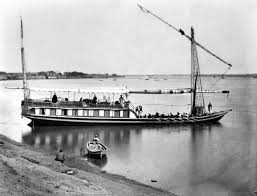
For thousands of years, people have travelled up and down the Nile in Egypt in passenger boats called dahabeahs. Drawings of these shallow-bottomed ships, kind of like barges with sails, can be seen on the walls of the tombs of pharaohs, but they weren’t just for the ruling class. Everyone used the dahabeahs to get from one place to another. Dahabeahs are still in use today; very few are motorized, and they often can be seen being towed by tugboats.
The French composer Camille Saint-Saëns (1835–1921) usually travelled during the winter, and in early 1896 he took a trip to Egypt. He ventured up and down the Nile in dahabeahs. He then holed up in a Cairo hotel for three weeks, during which time he composed his Piano Concerto No. 5, Op. 103 (1896), later given the nickname “Egyptian.” There is really very little that is Egyptian about this concerto other than the middle movement, which Saint-Saëns said included a Nubian tune that the crew of the dahabeah sang during his journey. The melody at the end of the movement includes sounds like chirping crickets and croaking frogs, sounds that Saint-Saëns also would have heard travelling on the Nile.
Hugh Macdonald wrote, “The most remarkable music is to be found in the middle movement, which is unlike anything else by Saint-Saëns or anyone else. It is not simply that most of the themes have a Middle Eastern character, based on modal intervals; it proceeds strangely from one episode to another without any apparent direction, like an improvisation, although the balance of the movement is cleverly controlled.”
Saint-Saëns, a child prodigy and a virtuosic pianist, was the soloist at the premiere of the concerto, which took place in 1896 in Paris. This concerto is one of his most popular, and it is performed throughout the world regularly. It also has been recorded dozens of times.
My classical music post for today is Camille Saint-Saëns: Piano Concerto No. 5: II. Andante.


Leave a Reply