

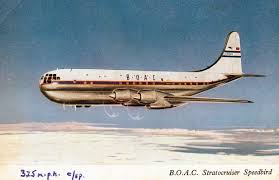
Music is a journey, taking listeners on an emotional and sometimes adventurous sonic path through time to new places both physical and spiritual. Some composers have chosen actual methods of transportation as their theme for this excursion. This October, the Daily Classical Music Post will feature music celebrating methods of transportation, from the land to the sea to the air.
Ralph Vaughan Williams – A Vision of Aeroplanes – Finzi Singers/Spicer, Bicket
Some people might not make the leap in their mind from the passage in the Book of Ezekiel that says “I looked, and behold a whirlwind came out of the north, a great cloud and a fire unfolding itself” to aeroplanes, but that’s exactly what the English composer Ralph Vaughan William (1872–1958) did. In giving his choral work with organ the title A Vision of Aeroplanes (1956), Vaughan Williams perfectly captures the sense of flying, of movement in the air, of propellers and jet engines, in this through-composed work in three sections (Moderato, Alla Marcia, and Più lento).
A Vision of Aeroplanes is a late work, and, as Andrew Carwood pointed out, there is very little of the typical Vaughan Williams style in this astonishing motet: “A vision of aeroplanes was written for Harold Darke . . . and was first performed under his direction on 4 June 1956. With its cataclysmic organ writing and whirling voice-parts it is a highly imaginative setting without a trace of pastoralism. Epic in style and proportion, the ‘vision’ has more than a hint of the film scores which had preoccupied Vaughan Williams for the previous ten years.”
John Quinn wrote, “So virtuosic is the organ writing that this piece might just as fairly be described as a motet for organ with choir! The organ part is fiendishly challenging, bristling with difficulties.” William Hedley wrote, “Vaughan Williams is in many respects an enigmatic composer. Whilst much of his music may be taken, as it were, at face value and enjoyed as such, obstacles arise when one starts to ponder on its meaning; the composer himself would have argued that the question was irrelevant. Few of his works pose questions so intractable as A Vision of Aeroplanes. The words, chosen from the first chapter of the Book of Ezekiel, tell of bizarre, humanlike figures which appear out of a whirlwind and fire, of wheels that rise and fall with them, of the noise of the beating of the creatures’ wings ‘as the voice of the Almighty’ and a throne upon which sits ‘the likeness of the glory of the Lord’. The main part of the work is Vaughan Williams at his most violent and uncompromising, the choral parts highly challenging technically, and the organ part even more so.”
My classical music post for today is Ralph Vaughan Williams: A Vision of Aeroplanes.


Leave a Reply