

“Everybody talks about the weather, but nobody does anything about it.”—Charles Dudley Warner
Classical music composers may not do anything about the weather, but they often have been inspired by weather and other natural phenomena. This August, the Daily Classical Music Post will explore some of these works and learn about the ways that different combinations of instruments can depict storms, volcanic eruptions, and climate change.
Bronze Horseman Suite:: VII. Anticipation. Allegro molto agitato
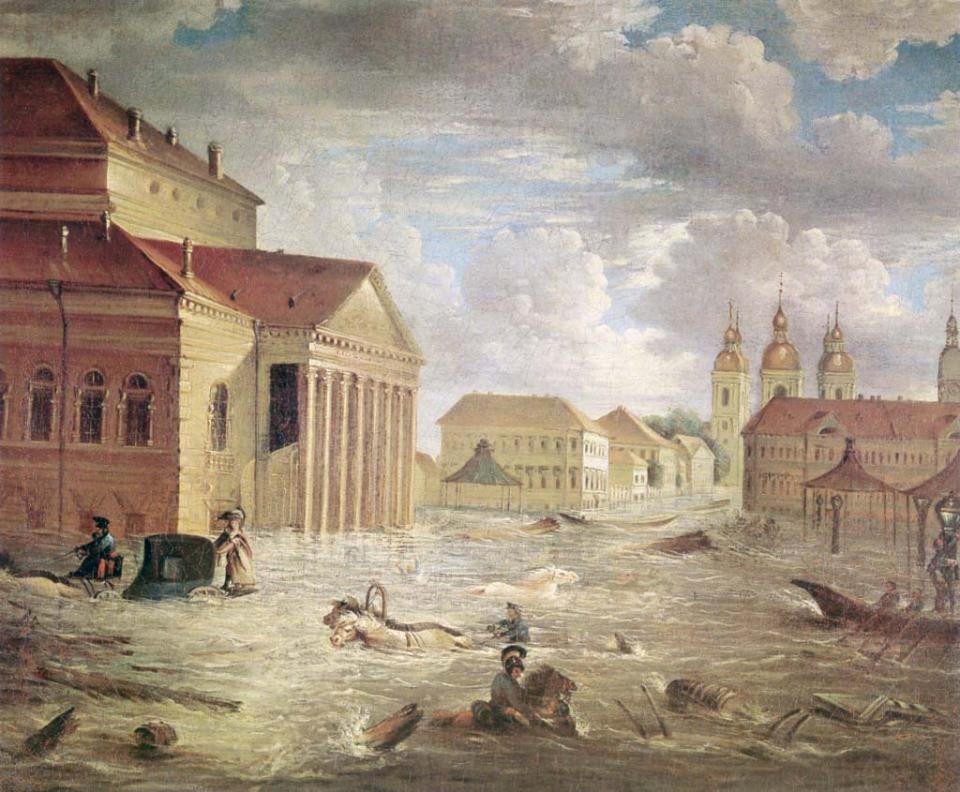
“The flood of 7 November 1824 was the greatest flood in the history of St. Petersburg. Short-lived storm-surges are not unusual in St. Petersburg, which is located on the delta of the river Neva, but this one far exceeded the normal levels. On the evening of 6 November 1824, a storm broke out over the Baltic Sea, abating only towards morning. It caused surges to move eastwards up the Gulf of Finland, and at 10 am the flooding began. By 2 pm the Neva was already returning to its course. However, during the course of the flood the Neva’s water level reached a record height of 4.20 m above sea level, making it the most destructive flood the city had ever witnessed.”—Kseniya Barabanova
The “founder of modern Russian literature,” Alexander Pushkin, wrote a narrative poem in 1833 commemorating the 1824 flood and the massive equestrian statue of Peter the Great, known as the Bronze Horseman, that sits in Senatskaya Ploshchad, pointing towards the River Neva. The Bronze Horseman highlights the conflict between the needs of the state and those of its citizens. The poem tells the story of a poor man, Evgenii, and his loved one during the flood. Evgenii curses Peter the Great for founding the city in a place where floods can take place, and he is particularly angry and distressed when his love dies in the flood. The Bronze Horseman comes to life and chases Evgenii all around the city. At the end of the poem, Evgenii dies.
In 1848/49, the Russian composer Reinhold Glière (1875–1956) composed a ballet based on Pushkin’s poem. Medny vsadnik (The Bronze Horseman), Op. 89, was one of Glière’s most popular ballets. The three-hour ballet is performed regularly in Russia. Glière organized some of the music into a suite, Op. 89a, in 1949, which also is performed often.
A Gramophone review of a recording of the suite said, “The big romantic melodies of The Bronze Horseman rarely seem contrived; for a product of 1949, one of the fallow years following Zhdanov’s infamous conferences, it seems a remarkably honest score. The real problem is whether it comes close to its Pushkin source, known to every Russian, in which a half-demented young clerk is chased through the streets of St Petersburg by the bronze statue of Peter the Great. . . . [T]he 45-minute suite features the terrifying statue not at all, conjuring the dark atmosphere of the tale only in the chromatic introduction and a very unsuccessful slice of storm music for the floods that drown the clerk’s beloved.”
My classical music post for today is Reinhold Glière’s The Bronze Horseman: VII. Anticipation. Allegro molto agitato.


Leave a Reply