

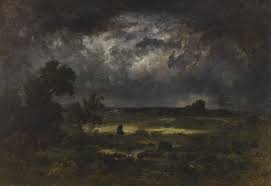
“Everybody talks about the weather, but nobody does anything about it.”—Charles Dudley Warner
Classical music composers may not do anything about the weather, but they often have been inspired by weather and other natural phenomena. This August, the Daily Classical Music Post will explore some of these works and learn about the ways that different combinations of instruments can depict storms, volcanic eruptions, and climate change.
Le portrait musical de la nature: III. L’orage accompagne des vents –
As we’ve seen this month, composers have been depicting storms in their compositions for some time. One of the most famous examples of this is Ludwig van Beethoven’s Symphony No. 6, also known as the Pastoral Symphony, composed in 1802–1808. But almost a quarter of a century before Beethoven’s five-movement walk through the countryside complete with thunderstorm premiered, another German composer wrote a five-movement symphony that anticipated Beethoven’s composition.
Justin Heinrich Knecht (1752–1817) was mostly known for his church music and theoretical writings, but he also composed operas and chamber music. One of his most interesting pieces was Le portrait musical de la nature, ou Grande sinfonie (Pastoralsymphonie), composed in 1784–1785. Knecht’s symphony was greatly admired, and although there is no direct evidence that Beethoven knew the piece, it is a possibility that he at least had some idea that it existed.
The five movements of Knecht’s symphony are very similar to Beethoven’s: I. Une belle contree ou le soleil luit; II. Le ciel commence a devenir soudain sombre; III. L’orage accompagne des vents; IV. L’orage s’appaise peu a peu; and V. La nature transportee de la joie. But, as Andrew Farach-Colton wrote, “The similarity is entirely superficial, however. Knecht’s Portrait is hardly a symphony at all, in the formal sense, and more a procession of images and episodes accomplished with little harmonic tension or thematic development.” Knecht’s storm is not as terrifying as Beethoven’s (none of that screaming piccolo), and the wind seems less like a gale and more like a breeze.
Jonathan Woolf wrote, “The methodology, and the stylistic influence, is more Mannheim than anything, which isn’t surprising when one appreciates that Knecht was born a few years before Mozart. His music is charming, pastel coloured, descriptive to a degree, conveying notions of the ‘sombre’ and ‘lowering’ as well as more radiant feelings. Crisp brass and percussion indicate turbulence and this happens with strategic intelligence in the central Allegro molto. The movements, whilst distinct, segue into each other in this performance so a seamless air is conveyed. . . . Unlike Beethoven’s own conception, Knecht’s is a landscape and, more importantly, skyscape uncontaminated by humanity. It is very much a study in tint and colour, an analogue in music of German landscape art.”
My classical music post for today is Justin Heinrich Knecht’s Le portrait musical de la nature: III. L’orage accompagne des vents.


Leave a Reply