

“Everybody talks about the weather, but nobody does anything about it.”—Charles Dudley Warner
Classical music composers may not do anything about the weather, but they often have been inspired by weather and other natural phenomena. This August, the Daily Classical Music Post will explore some of these works and learn about the ways that different combinations of instruments can depict storms, volcanic eruptions, and climate change.
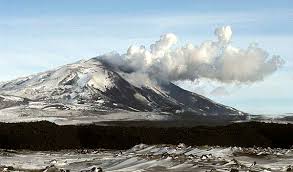
The stratovolcano Hekla is one of the most active volcanoes in Iceland. Known since medieval times as the “Gateway to Hell,” and according to myth a special gathering place for witches, this volcano has erupted many times since recorded history began: at least 30 significant eruptions as well as countless minor ones. Hekla’s eruptions have affected weather patterns, including causing volcanic winters, altering sunlight penetration via ash clouds, and leading to increased sulphur-infused precipitation.
The Icelandic composer Jón Leifs (1899–1968) mostly wrote for large orchestra, and many of his pieces were inspired by Icelandic natural phenomena. Leifs witnessed the year-long eruption of Hekla that began in 1947. He composed a tone poem, Hekla Op. 52, in 1961, remembering what he had observed. The orchestra calls for a massive percussion section, including anvils, stones, steel plates, chains, sirens, cannon shots, and other unusual instruments meant to mimic the sounds of a volcanic eruption. At the premiere, the orchestra members asked for earmuffs as the percussion was so loud. One reviewer called Hekla “the loudest piece of music ever written.”
Laurence Rose wrote, “Characteristically, Leifs thought little about the practicalities of his piece, and called for an array of instruments that were either unobtainable—massive church bells for instance—or unplayable, such as rapidly repeating shotguns. Rocks that ring with musical pitches were found, and ships’ chains and steel tubing were scrounged from the Reykjavik dockyards. Whether or not the exact sounds in the composer’s head made it to the concert hall, the effect at its 1964 premiere would have resonated throughout the musical scene in Iceland, liberating a surge of edge-of-the-world originality which has yet to cease.”
Rob Barnett wrote, “The notes seem to emerge from the hot rocks, fumaroles and chiroplastic floes. Lava and magma erupt, stones are heaved like great mortar shells high into the super-heated air. The percussion specification for the work reads like a shopping list from a demonic orchestra. . . . Sirens, great bells, tuned stones, giant ship chains and synthesised cannon and shotgun reports all slam and shudder through this extraordinary score.”
My classical music post for today is Jón Leifs’ Hekla.


Leave a Reply