

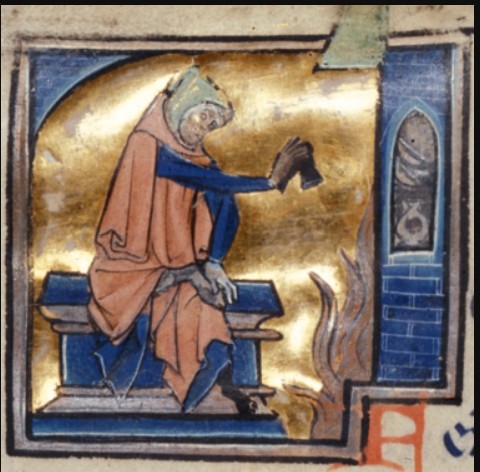
“Everybody talks about the weather, but nobody does anything about it.”—Charles Dudley Warner
Classical music composers may not do anything about the weather, but they often have been inspired by weather and other natural phenomena. This August, the Daily Classical Music Post will explore some of these works and learn about the ways that different combinations of instruments can depict storms, volcanic eruptions, and climate change.
Mirie it is while sumer ilast (from original manuscript) voice & medieval harp
Complaining about the weather is not a new phenomenon. People have always griped about cold winter weather, for example, and our great friend Anonymous composed a little ditty about this way back in the early 13th century, around 1225. Mirie it is is considered to be the oldest surviving secular song in English. It was rediscovered in the late 19th century along with two French songs inside a Book of Psalms. The dialect of the text is from the Midlands.
Ian Pittaway wrote, “The two earliest surviving secular songs in English are both about the weather, the other being Sumer is icumen in, c. 1250, about the sights and sounds of summer. . . . Mirie it is sums this up, opening with memories of summer birdsong, implying warmth and plentiful food, immediately contrasted with present winter: short hours of daylight (‘Ey ey what this nicht is long’), freezing temperatures and harsh weather (‘windes blast and weder strong’), lack of fresh food bringing a greater propensity for illness (‘Soregh and murne and [wast]’) and therefore, among the least hardy, potential death.”
We’ll never be exactly sure how this song should sound. The manuscript was in pretty bad shape and also was likely just the first page of a multi-page work. The style of notation is confusing: some note shapes are indistinct and there are marks all over the page that may or may not be part of the music. Note values also are uncertain, and most likely follow some speech patterns. Although some secular medieval music was modal—that is, related to the ecclesiastical modes—Mirie it is does not appear to fit into any of those modes. It also isn’t clear what if any accompaniment was intended, but medieval harp seems to fit pretty well.
My classical music post for today is Anonymous’ Mirie it is.


Leave a Reply