

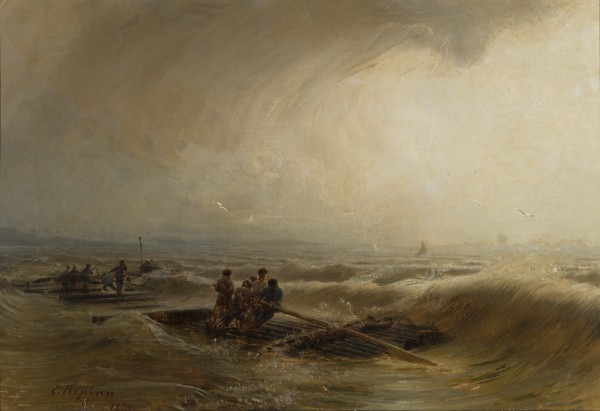
“Everybody talks about the weather, but nobody does anything about it.”—Charles Dudley Warner
Classical music composers may not do anything about the weather, but they often have been inspired by weather and other natural phenomena. This August, the Daily Classical Music Post will explore some of these works and learn about the ways that different combinations of instruments can depict storms, volcanic eruptions, and climate change.
Katia Kabanova: Act III, Esc I – La Tormenta
There’s nothing like a good storm scene in an opera. It gives the orchestra a chance to go wild, particularly the percussion and brass sections, and the lighting and sound crews have an opportunity to pull out all the stops to create the impression of a storm. Storms also can be used to advance the story of the opera, either by revealing a character’s inner emotions or to bring a conflict to a head.
The Czech composer Leoš Janáček (1854–1928) based his three-act opera Káťa Kabanová (1921) on Alexander Ostrovsky’s play The Storm, which was a work of social criticism aimed at the Russian merchant class. Vincenc Červinka translated the play, which tells the story of a woman driven to suicide by the hypocritical morality of society, from the original Russian to Czech. Káťa is trapped in a loveless marriage and is ridiculed by her mother-in-law. She consoles herself in the arms of another man but feels guilty. When a violent storm approaches her town, Káťa publicly admits her affair. She then runs out into the storm and throws herself into the Volga.
Nick Kimberley wrote, “Where would opera be without its storms? From Gluck through Mozart and Verdi to Britten, bad weather has been a means to raise the emotional temperature, to unleash the musical tumult. So it is in Janácek’s Katya Kabanova, premiered in 1921 but based on Ostrovsky’s play The Storm, written in Russia 60 years earlier. . . . The storm that breaks in Act 3 highlights the provincialism of the social world that has Katya in its grip. More importantly, for Janácek if not for Ostrovsky, it embodies the emotional crisis that precipitates Katya’s self-destruction. That’s what the commotion in the orchestra pit tells us, and the denouement is swift and terrible. The thunder has barely cleared the air before Katya has thrown herself into the Volga.”
My classical music post for today is Leoš Janáček’s Káťa Kabanová: Act III scene 1.


Leave a Reply