

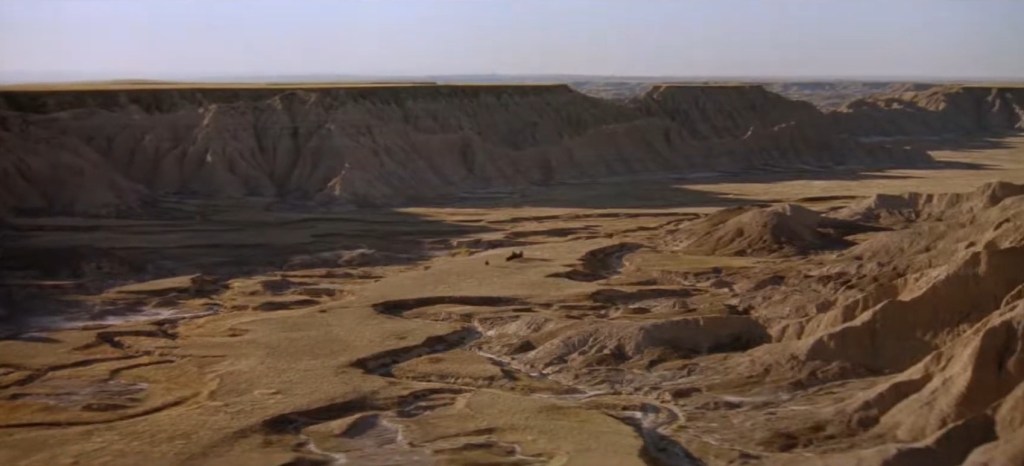
Ask people what genre they think film music is—is it classical? You will get widely varying responses. For some people, film music is a subgenre of classical music; for others, it is a completely separate genre that stands on its own. This June, the Daily Classical Music Post will look at the origins of film music and discover how it has evolved.
Dances with Wolves (1990) – ‘Journey To Fort Sedgewick’ scene (Part 1) [1080]
Dances with Wolves (1990) – ‘Journey To Fort Sedgewick’ scene (Part 2) [1080]
Epic Westerns, a subgenre of the Western film that celebrates the “Old West” and is often set in or around a time of conflict or war, were particularly popular until the 1960s, when Hollywood turned to making films about the Vietnam War, the civil rights movement, and the sense of disillusionment that people in the United States of America were experiencing. The actor and director Kevin Costner is credited with reviving the epic Western with his Dances With Wolves (1990), and the score had a great deal to do with the success of the film.
The English composer John Barry (1933–2011) grew up immersed in the worlds of film and music; his father was a projectionist during the silent era and later owned a chain of cinemas in northern England, and his mother was a classical pianist. With this background, it is completely understandable how Barry became one of the greatest film composers of all time. His scores were nominated for Academy Awards six times, and he won five of those times, two for Born Free and one each for The Lion in Winter, Out of Africa, and what many consider to be his masterpiece, Dances with Wolves.
Barry’s score with its lush, sweeping orchestration perfectly depicts the wide-open plains, most particularly in the “Journey to Fort Sedgewick” section near the beginning of the film. Jonathan Broxton wrote, “When Basil Poledouris—who was Costner’s original choice to score the film—decided to score Flight of the Intruder for his old friend John Milius instead, the project fell into Barry’s lap. . . . He responded to Costner’s film with what is arguably the greatest score of his career, an enormous, romantic, sweeping, theme-filled epic which characterizes everything that is great about the Englishman’s music. It’s a grand, multi-layered work which contains at least eight different themes and variations, and several standalone set-pieces, all of which inhabit the same sonic world, and all of which are singularly stunning. . . . While others may rightly praise John Barry for his Bond scores, or for his excellent work in the 1960s and 70s on such epic works as Zulu or The Lion in Winter or The Last Valley, for me Dances With Wolves remains his magnum opus: easily the best score of 1990 and a truly deserved Oscar winner, the best score of his entire career, and (in my opinion) one of best twenty or thirty scores in the history of cinema.”
Barry said in an interview, “Although it’s a big score, and a long score, in a strange way it had to be very simple. Dunbar is a very simple, decent man. It’s a lovely story about his encounter with the Sioux tribe, and it has a kind of purity to it. That was the most difficult thing, keeping that simplicity for most of the music.” Craig Lysy wrote of “Journey to Fort Sedgewick,” “The theme offers a bright, major modal affirmation of the pristine beauty of the American West. Confident strings brimming with optimism join with resounding horns nobile, which speak to the grandeur and sense of wonderment John feels as he travels to his destiny. The confluence of music and cinematography is breathtaking.”
My classical music post for today is John Barry’s Dances With Wolves: “Journey to Fort Sedgewick.”


Leave a Reply