

Ask people what genre they think film music is—is it classical? You will get widely varying responses. For some people, film music is a subgenre of classical music; for others, it is a completely separate genre that stands on its own. This June, the Daily Classical Music Post will look at the origins of film music and discover how it has evolved.
Blade Runner – Opening Titles (HQ)
We’ve already seen this month that not all film composers come from a traditional classical music background. Many did train extensively in classical or jazz music, and several had degrees in composition and theory and harmony. But directors and producers also sought out popular musicians and composers, particularly from the late 1960s on, to compose soundtracks. One of the pop musicians who had an enormously influential effect on film scores was the Greek composer Vangelis (1943–2022).
Vangelis never learned to read or write music. In an interview, he said about the way that he composed a film score, “I start building, looking for the basic pattern and adding strings, brasses, woodwinds or percussions as they seem needed. My score is not on paper—but on a tape. I try to add successive layers—electronically through the synthesisers and the acoustic effects when I need them.” Vangelis had composed scores for documentaries, advertisements, and short films, but his Academy Award–winning music for the feature-length Chariots of Fire (1981), particularly the main theme, made him world-famous and very much in demand.
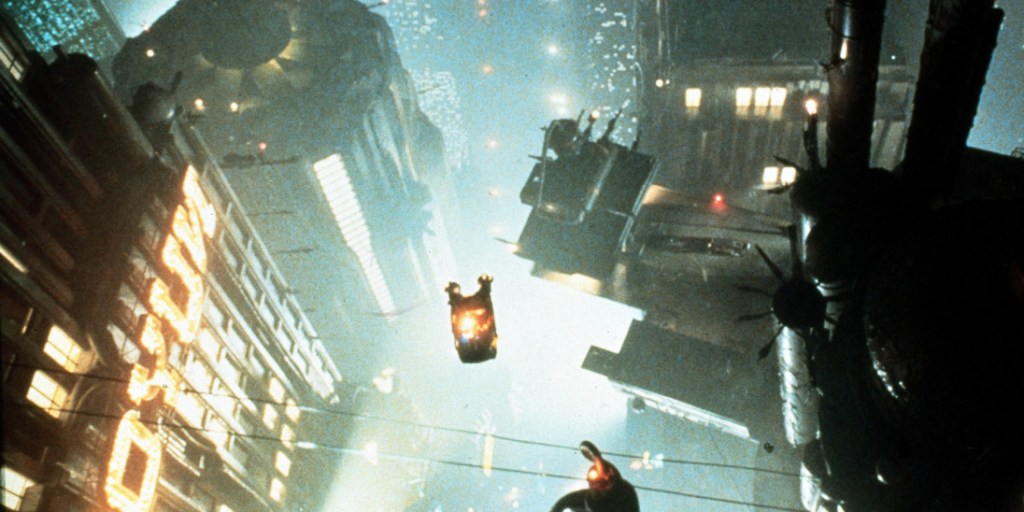
The director Ridley Scott had worked with Vangelis on an advertisement for Chanel, so when Scott was looking for someone to compose a score for his dystopian science fiction noir film Blade Runner (1982), Vangelis immediately came to mind. Piotr Orlov wrote, “Work officially began on the score at Nemo [Vangelis’ London studio] in December of 1981, with Vangelis receiving footage from the editing room on VHS tapes, scene by scene, then processing the visual inputs and cues, creating live takes using the dozen or so synthesizers at his studio. This immediate integration of sounds and vision was key in making the music responsive to the unfolding scenes and the atmosphere Scott had created. They were not simply connected through aesthetics or the call-and-response of the narrative, but through a shared emotional tonality and fully cohesive sensual environment: just cold enough to be artificial, just feeling enough to be alive.”
Vangelis used his signature synthesizer, the Yamaha CS-80, for most of the music. We saw earlier this month how Wendy Carlos had used earlier iterations of analogue synthesizers in her electronic versions of classical music. Although synthesizers had advanced considerably by the early 1980s, as the nemostudios.co.uk site notes, “Many old-school composers and music conservatives at the time believed that the use of synthesisers distanced the music performer from direct contact with the musical instrument, and they argued that, when used in film scores, the new electronic instruments could never capture the same level of warmth and emotion as when a score is written for a symphony orchestra, or when played directly by a musician on their instrument. . . . [Vangelis] performed using synthesisers because these instruments allowed him to spontaneously create symphonic works without the aid of session musicians.”
Zac Johnson wrote, “Vangelis’ soundtrack to the 1982 futuristic noir detective thriller Blade Runner is as bleak and electronically chilling as the film itself. . . . Vangelis creates haunting soundscapes with whispered subtexts and sweeping revelations, drawing inspiration from Middle Eastern textures and evoking neo-classical structures. Often cold and forlorn, the listener can almost hear the indifferent winds blowing through the neon and metal cityscapes of Los Angeles in 2019.” Hamza Ali Zahurullah wrote, “Greek composer Vangelis’ score for the 1982 film ‘Blade Runner’ is, without a doubt, the embodiment of film music perfection. . . . Ordinarily, the recommendation to listen to a film’s score isn’t a recommendation to see the film it accompanies, and the same holds true in the reverse. However, ‘Blade Runner’ and its respective soundtrack are the exception to this rule. Both stand as works on their own, but they add up to something more than the sum of their parts. It is ultimately for this reason that the Vangelis score is a truly great piece of cinematic music, and it should not be missed.”
My classical music post for today is Vangelis’ Blade Runner: Opening Titles.


Leave a Reply