

Ask people what genre they think film music is—is it classical? You will get widely varying responses. For some people, film music is a subgenre of classical music; for others, it is a completely separate genre that stands on its own. This June, the Daily Classical Music Post will look at the origins of film music and discover how it has evolved.
Film scores are an important emotional element of a film, echoing or enhancing what the characters are experiencing. The music can help to draw in the audience. Andreas Babiolakis wrote in “Understanding Film Scores and Soundtracks on Their Own,” “I think it is a little fruitless to separate a score or soundtrack completely from the films they come from. Great film scores often succeed because of how they affect scenes from a film. When you revisit the film in musical form, you are reminded of the tones of the film, the scenes in question, and your memories of having seen this work for the first time.”
But what about a score written for a film with no characters, no dialogue, nothing but images? The experimental documentary film Koyaanisqatsi, released in 1982, had no dialogue or sound effects. It was described by its director, Godfrey Reggio, as an “essay in images and sound on the state of American civilization.” The only sound was the soundtrack by the enormously influential American minimalist composer Philip Glass (born 1937).
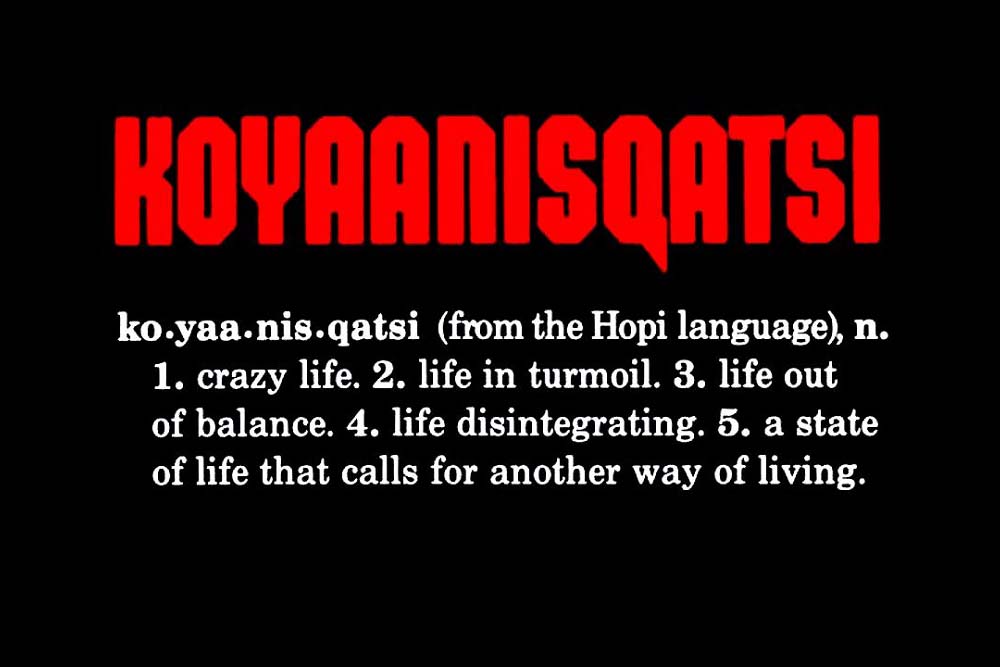
Koyaanisqatsi is a Hopi word meaning “life out of balance.” Reggio’s film uses stop-motion and time-lapse photography to contrast natural landscapes with urban environments and technology. Glass’s style of repetitive phrases and complex layers works perfectly with the often disjointed and sometimes unfamiliar images on the screen. The opening chant sets the tone immediately with its “otherworldly,” ominous atmosphere. Glass had discovered Indian music in the mid-1960s, and he worked for a time as an assistant to Ravi Shankar. The hypnotic structure of Indian music influenced Glass, and that influence is felt throughout his score to Koyaanisqatsi.
Glass’s mesmerizing score includes orchestral instruments, electronic instruments, keyboards, and vocals. Glass described what he saw as the message of Koyaanisqatsi: “There seems to be no ability to see beyond, to see that we have encased ourselves in an artificial environment that has remarkably replaced the original, nature itself. We do not live with nature any longer; we live above it, off of it as it were. Nature has become the resource to keep this artificial or new nature alive. . . . The film’s role is to provoke, to raise questions that only the audience can answer. This is the highest value of any work of art, not predetermined meaning, but meaning gleaned from the experience of the encounter.”
Roger Ebert wrote in his review of the film when it was first released, “‘Koyaanisqatsi’ is an impressive visual and listening experience, that Reggio and Glass have made wonderful pictures and sounds, and that this film is a curious throwback to the 1960s, when it would have been a short subject to be viewed through a marijuana haze.” Alex Brannan wrote, “Its Philip Glass score is one of the best the cinema has ever produced.” Slarek and Camus wrote in their review of the film and music, “Glass’s music is building and building and the cutting is sublime. At 16 minutes and 28 seconds in, we hear the first bars of what’s become Glass’s signature style. . . . [I]mages and music have rarely been partnered like this in cinema and it almost feels like Reggio and his editor would suggest a cut and Glass would come in and let them know how many frames it should be. The editing of both is sophisticated and absolutely pin sharp taking in both languid and frenetic. If the cuts came before the music, then the editor must have been a trained musician. If the music came first (how would Glass know what he was composing to?) then the editor’s job was more or less done.”
My classical music post for today is Philip Glass’s Koyaanisqatsi.


Leave a Reply