

Ask people what genre they think film music is—is it classical? You will get widely varying responses. For some people, film music is a subgenre of classical music; for others, it is a completely separate genre that stands on its own. This June, the Daily Classical Music Post will look at the origins of film music and discover how it has evolved.
Saul Bass: Anatomy of a Murder (1959) title sequence
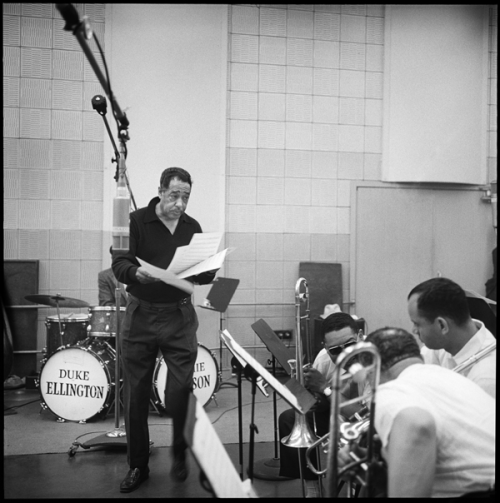
In the early days of Hollywood, Black people were almost entirely excluded from both onscreen roles and any behind-the-scenes jobs. Although Oscar Micheaux did make a silent film based on his 1918 novel The Homesteader, Black directors and musicians were rarely part of early filmmaking. Jazz musician Benny Carter did some work on Stormy Weather (1943), but no studio hired any Black musician to compose an entire score until 1959, when Otto Preminger asked Duke Ellington (1899–1974) to write the soundtrack to Anatomy of a Murder.
David Johnson wrote, “In 1959 Duke Ellington was still enjoying the professional and artistic rebirth that had begun in 1956 with his triumphant performance at the Newport Jazz Festival, and his score for Anatomy Of A Murder is now seen as a highlight of his post-Newport era. . . . Preminger sought out Ellington’s services because he knew Ellington’s cultural stature would attract further attention to his new project.” Steve Sutherland wrote, “Among the film’s cast was big band jazz supremo Duke Ellington [note: Ellington had a cameo as a band leader], who was commissioned to write the score—the first time an African-American had done so for a major studio. When asked why he chose Ellington to soundtrack his movie, Preminger replied he felt the great band leader would ‘produce a freshness which an experienced film composer might no longer possess’.”
Ellington found writing a film score challenging; composing music that accompanied scenes and emphasized the action was very new for him. He spent several weeks away from his band—something he had not done before—on location as the movie was being filmed so he could get inspiration. Philip K. Scheuer wrote, “Perhaps the pleasantest memory I have of a week end on Michigan’s Upper Peninsula, where ‘Anatomy of a Murder’ was filmed in its entirety, is of Duke Ellington playing, informal style, at the piano . . . The Duke sat down and nonchalantly worked from Debussy doodlings and Ravel rationcinations into typical Ellington improvisations.” This “doodling” paid off brilliantly, and everyone at Columbia Pictures was thrilled with the resulting score. Tom Piazza called Ellington’s soundtrack, which won three Grammy Awards (Best Sound Track Album, Best Performance by a Dance Band, and Best Musical Composition), “the closest thing we have to a vernacular American symphony.”
Richard Domek wrote, “With its orchestration (massed ensemble sounds juxtaposed with chamber-like writing), formal design (blues, song form, ‘formless’ segments), thematic transformation serving as a means of musical growth, unity in the midst of compositional collaboration, advances in the handling of tonality, harmony, and dissonance, exploitation of the ‘suite’ as a compositional form, adherence to the coloristic ‘Ellington Effect,’ and even in transmitting an indefinable ‘essential expression of jazz,’ Anatomy’s music affords a great comprehension of what Ellington, (Billy) Strayhorn, and the orchestra were about in a later and fruitful period for the band.”
My classical music post for today is Duke Ellington’s Anatomy of a Murder: Main Title.


Leave a Reply