

Ask people what genre they think film music is—is it classical? You will get widely varying responses. For some people, film music is a subgenre of classical music; for others, it is a completely separate genre that stands on its own. This June, the Daily Classical Music Post will look at the origins of film music and discover how it has evolved.
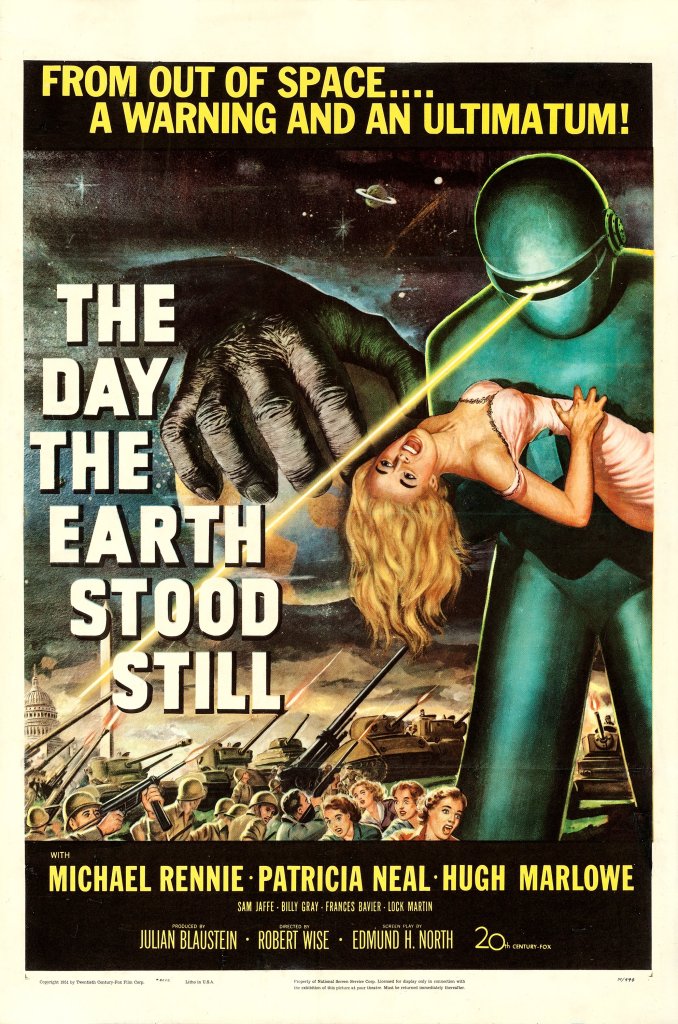
The Day the Earth Stood Still (1951) title sequence
In the 1920s, during the Silent Era, cinemas in major cities had their own full orchestra as well as an organ. When sound came to the movies, the major Hollywood studios maintained their own in-house studio orchestras. James Knippling wrote, “The movie studios would keep full orchestras in constant employment, because they had to score every film they made, and they churned them out much quicker than today. . . . Even if the film might be set out in the country with bullfrogs, you’d still have the orchestral score—you wouldn’t have harmonicas and banjos. It was universal.” This notion of “invisible” music, which let the audience know in a subliminal way how to react to what was happening in the movie, was hilariously parodied by Mel Brooks in his 1977 film High Anxiety (Dramatic music Mel Brooks (High Anxiety 1977) – composer John Morris). In the late 1960s, studios began to move away from original orchestral music, opting instead for pop music (Bonnie and Clyde and The Graduate, both released in 1967, were the first “mixtape” movies).
In the 1950s, studios still employed full-time orchestral musicians. Changes were on the way, however. The American composer Bernard Herrmann (1911–1975), recognized as one of the greatest film score composers of all time, was one of the leaders of these changes. Among his most well-known scores are those for Citizen Kane, Psycho (side note: Alfred Hitchcock didn’t want any music at all during the shower scene; Herrmann talked him into the “stabbing” sound), and Vertigo. Herrmann was influenced by the modernist American composer Charles Ives, particularly in the use of atonality and ambiguous harmonies. Herrmann was a master at creating tension in his scores. And even in his early scores, he embraced the opportunity to compose for unorthodox ensembles. Herrmann was an innovator, and a great example of this is his otherworldly score for The Day the Earth Stood Still (1951), his first major Hollywood commission.
Kevin Gordon wrote, “When Herrmann received this commission—his first—he pulled out all the stops. His scoring was groundbreaking using an odd combination of instruments: electric violin, bass, and cello with organs, glockenspiels, harps, tubas and pianos, to portray an uneasy feeling right from the opening credits. But the instrument that set the score apart from all previous scores was the theremin.” (See my post https://dailyclassicalmusicpost.com/2023/09/03/daily-classical-music-post-128/ for more information on this unusual instrument.) Once other composers realized how perfectly the sound of the theremin conveyed creepiness, they used it as well, particularly in thrillers and science fiction films.
Herrmann followed the tradition of leitmotifs in the score, but somehow the sparseness of the orchestration as well as that creepy theremin makes everything seem new and fresh and totally different from what came before. He also refrained from using the entire ensemble throughout, instead choosing sub-ensembles for each cue. He also employed a new technique that George Marshall calls “multi-tracking”: “Rather than a technique of layering individual recordings to create a single sounding performance of a composition, in this instance, it is two individual parts of the cue. In these two-part cues, there tends to be a cue that underscores the scene and a secondary cue that is used as a stinger. This stinger is superimposed and synchronised to the actions on screen more precisely and, possibly, laid over other cues too. . . . Cutting edge then, the technique has utility now.”
My classical music post for today is Bernard Herrmann’s The Day the Earth Stood Still: title sequence.


Leave a Reply